
Lolly and Maurice

It’s funny how life likes to close circles Auntie thought as she tipped backfill into Maurice Turners grave.

She had been at his birth, his mother had gone into labour during his father’s funeral and Auntie had been in the wings waiting to fill the man’s grave. His birth had been quick, Maurice had seemingly been in a hurry to get at the world.

Auntie knew most people who rested here, bar those who had passed long before her time and Maurice was no exception. A nice boy, quick, slight and into everything. He’d had a hawkish face, which suited him as he bobbed and dashed around the place. Smart and likeable, mostly. Maurice had done well at school, earned a scholarship and had even managed to get himself all the way to university in neighbouring St Almany. At this point he had dropped off Aunties radar for she seldom left the cemetery let alone Kilder.

It wasn’t until her niece, Lolly had gone to St Almany to have her wisdom teeth pulled, that Auntie heard of Maurice again. Lolly met him by chance in the street, and he had taken her out for a fine dinner, then to the theatre. Not used to being around people with coin to splash Lolly had been very taken by him. She remained in touch with Maurice when she returned to Kilder, writing to him and seeking opportunities to visit St Almany.

Once done with school Lolly pursued a stage career, which took her back to St Almany and Maurice. Lolly had been beautiful and wasn’t short of suitors, but it was only Maurice that she had eyes for.  It wasn’t long before they were engaged, which Lolly’s mother thought a good thing, as the girl couldn’t act and clearly wasn’t going to make her fortune on the stage. Better that she marries and perhaps start a family. 

Maurice had become a wealthy young man, having started a successful shipping company. With his wealth he bought up land around Kilder including the old Rhodes estate. The estate had once been a grand residence, with extensive orchards and grazing. He intended it to become the family home and set about returning it to its former glory.

Lolly and Maurice’s wedding was an extravagant affair. Their guests were treated to a lavish feast, dancing and performances by friends from Lolly’s theatre days. Auntie had been invited, but had not attended, she didn’t go in for crowds or the formalities of the living.

For the first year of their union, they lived in St Almany, but when Lolly fell pregnant, she returned to Kilder taking up residence in the Rhodes Estate. She had an easy pregnancy, glowing throughout. At weekends Maurice would come down from the city and they would entertain guests. The love and joy of the young couple seemed to flow from their home and out into the wider community, rippling out like a flame. For the first time in years there was a sense that great things could happen in Kilder.

The night the baby arrived was still and calm, except the sky which had been lit by the burning debris of a passing meteor. Auntie had watched the flares of light and energy in wonder from the cemetery. When she heard Lolly’s child had chosen that night to be born, she couldn’t help but wonder about the nature of this omen. Good or bad? Whichever it was there was power bound into it.

A month later Auntie dug a new grave. She chose the spot carefully, on the edge of the cemetery, near the riverbank among a cluster of mayhaw trees, which would cascade with white blossoms in the spring and flame red with rich ripe fruit in the flowers wake. Lolly’s child was laid to rest here, amongst the trees. The funeral had been short, the parents were statuesque in their grief, and that night Maurice had returned to St Almany.

Lolly remained on the estate and for a while Maurice had travelled between the two homes, but storms, rival firms and even pirates had meant that his business was in difficulty, and he couldn’t be spared. Eventually he stopped travelling between his homes and stayed in the big city leaving his wife alone in her grief.

The pain of loss changed Lolly, she was no longer a bright and beautiful creature. Her mother and friends tried to provide her with solace and comfort, but she would take none. She blamed herself for what had happened and Maurice’s absence only reinforced this.

For a year Lolly kept to herself and was seldom seen in the daylight hours. On the anniversary of their child’s birth Auntie found flowers at the child’s grave, a bright cluster of asters laid neatly before the headstone. Soon after the estate which had been in deep mourning along with its mistress returned to life. The gates reopened, the household was restaffed, the orchard workers returned, and livestock brought to auction. A shroud had been lifted.

However, Lolly remained largely unseen by those who knew her, reclusive, she communicated with notes and letters only, but that winter things changed. Invitations came out, inviting the whole town to a New Years party.

The event was extravagant, and it was only the first of many. Soon it was not just the Kilder folk who were invited, but also those from distant regions. Each party grew in scale and expense, and Lolly was the queen of excess. When she started to invite theatre groups to the estate to entertain people began to talk, for everyone knew about Maurice’s money woes, but Lolly continued to spend, and they continued to attend. Maurice remained in St Almany, he didn’t come to chastise his wife for her spending and their credit for now remained good, but everyone noticed the growing rift between husband and wife.

A particularly famous troop of performers came over from Europe that season and they brought the roof down in every town and city they visited. Lolly just had to host them, she pulled every string and spent a royal fortune to get them out to the Rhodes Estate.

The troop arrived under the light of a full moon, in carriages pulled by fine black horses. Auntie watched them pass through the town and believed she recognised them for what they were. The following morning, she went out to the estate and asked to speak to Lolly, but she was turned away. Undeterred she had found another way in but was sent packing when she reached the house. Still, she tried again, asking a maid to take her niece a letter, the girl promised she would.

That night all the towns folk were invited to the estate, except Auntie. An elaborate production of Midsummer Night’s Dream was put on by the Europeans and the next day it was all anyone spoke about. Auntie felt slightly calmed as nothing untoward had happened.

Another night, another performance, the comic opera Princess Ida, this time with guests from all over the county not just Kilder. Auntie watched the fireworks that concluded the party from her bench at the cemetery. As the coaches rolled back to town, she began to wonder if she had been wrong about the performer’s nature.

The third night was the troops final performance. Kilder buzzed with excitement and gossip about the extravagances Lolly had planned.

A knitting in Aunties stomach set her worrying. She decided to seek her niece out, she needed reassurance that all was well. It was easy to slip into the estate this time for every tradesman and his dog had business there that day and she was just one of many people arriving. She let herself into the house, slipping past the maid she had previously asked to deliver her warning and made for Lolly’s bedchambers. She found the curtains drawn, but the bed had not been slept in. It was at this point she was discovered and was escorted from the property. As she was roughly handled down the drive, she caught a glimpse of Lolly emerging from one of the large carriages in which the performers travelled. Even from this distance Auntie could see the radiant glow about the girl, they locked eyes, then Lolly turned her back on Auntie.

Auntie watched as carriage after carriage rolled past her cemetery on route to the estate. The hum of the party could be heard over the cicadas, music and voices rising and falling. Later when she retired to bed Auntie noticed an orange glow on the horizon, she opened her window and the air that crept through carried the scent of smoke.

The fire had started in the kitchen, spreading quickly, trapping many of the guests inside. By the time an organised response was underway it was too late, forty-four souls had perished. When the news reached Maurice, he rushed back to Kilder and it was he who pulled Lolly from the rubble.

His wife was utterly unscathed, her clothes were burnt, but she hadn’t a bruise or singe upon her. She was hurried back up to St Almany for medical treatment, but it was unnecessary, and she was discharged into Maurice’s care. Once back in their town house she took to the bedchamber and wouldn’t leave.

Auntie interred the locals over the next few days and helped arrange for the final passage of the deceased who had further to travel. The cemetery had been a busy place, busier than Kilder which was now much reduced and deep in mourning. Though behind closed doors and in quiet places whispers began, had Lolly had started the fire.

While his wife refused to be part of the world and remained locked away in her bedroom Maurice’s money woes came calling.  The estate had been mortgaged to cover his business debts, and with the fire the debt had been called. His remaining assets were seized, the business foreclosed on, and the estate sold.

Months later on a moonless night Maurice and Lolly returned to Kilder, taking up residence in their only remaining property, a small house near the forest. Nobody saw Lolly, but Maurice was seen pacing on the porch or walking in the woods. He came to the cemetery daily, placing a single lily at his child’s grave. Where he got the coin for the flower from Auntie didn’t know, but she never asked about it. However, at her sister’s behest she did approach him to enquire after Lolly. His voice was slow and heavy, his answer short – she was recovering.    

The weeks passed, the seasons changed, Lolly remained an unseen entity while Maurice became wraith like in his demise.

One morning Auntie found fresh flowers at the child’s grave, not the singular lily she was used to but the purple blue asters. The following day Maurice’s body was found. He had been brutally slain. The coroner concluded it was an animal attack and when Auntie was called upon to prepare him for burial, she agreed that something wild had ended his life.

Of Lolly there was no sign. The house had been vacant when the sherif went to inform her about her husband’s passing. A search had been conducted but nothing turned up, she had simply vanished.

So here was Maurice, resting in a shallow grave just yards from where he had been born, thirty-one years ago. Funny how things worked out. Auntie pulled her pipe from her pocket and settled down to wait. Not long after sunset a shadow came creeping. Lolly. She approached and paused by the shifting soil in the grave before her. A hand clawed its way through the dirt, an arm, another hand, then Maurice’s face, filthy and feral. Auntie sighed, tapped out the pipes embers and picked up her shovel. Duty called.

© Juliet Robinson 2024, all rights reserved.

Image – Bing Microsoft Image Creator – Mississippi estate

Mind Burble

This piece was originally much shorter and was written for a workshop. I wrote it following a trip to New Orleans which should tell you were all the ideas came from, least surprising of all the I guess would be the appearance of vampires. It was a lifelong dream to visit New Orleans and I did hope it would inspire a story.

I enjoyed leaning into the tone and the tropes in this piece. It was nice to come back to it, to make changes and finish it, as lately I am really struggling to finish anything and I don’t feel like I am making any progress with my long term projects. So yes a box ticked, a story finished and a vague sense of achievement, even if I am not wild about the story.
A Job for Life

‘I woke at six. I need no alarm clock. I was already comprehensively alarmed.’
Silence followed Murray’s smug words and he shot his audience a peevish look.

Only Owlish seemed to be listening, he blinked two large eyes and shuffled his chicken wire wings. Murray pursed his lips and decided to help them get to the punchline. He waved his left arm in the air and pulled his sleeved down, exposing raw, puckered skin, and an ugly rend which dominated most of the ruined limb. Nestled amongst the pus and tendons was a green Bakelite alarm clock, its second hand had fallen off, but the hours and minutes still ticked.

‘Comprehensively alarmed.’ He shoggled the limb and blood started to seep from the tender flesh.

Owlish turned his head away, the whole hundred and eighty degrees.

‘Clearly I’m only one whose had their coffee this morning!’ Murray grumbled. He picked up a spanner and wiped dried blood from its head. ‘Speaking of coffee – De’Longhi?’ the dark corners of the shed shuffled, but nobody came forward. ‘De-Loooonnnghiiiiiii.’ 

A trundle of wheels answered Murrays call as finally De’Longhi rolled forth. Her feet had been replaced with office chair wheels, her lovely long legs curved upwards, to her hips which now supported a rusty coffee machine, upon which her heavy bosom rested nestled amongst the stacks of cups.

‘Cappuccino,’ Murray demanded. ‘Anyone else?’ No reply.

De’Longhi smiled weakly and started his order. Her gel nails were chipped and as she steamed the milk flakes of pink tumbled into the froth, where they spun and twisted.

‘You do make a fine coffee,’ Murray offered her rare praise. ‘Shame you had to go on maternity leave, the office wasn’t the same without you. I told you when you started, we are a family. You don’t walk away from your first family.’ He glanced down at her wheels and smirked.

De’Longhi poured the espresso and topped it with steamed milk and froth. Her mottled hands were shaking and a maggot fell from her flesh and plopped into the beverage. She started to shake, cups clattering.

‘Extra protein,’ Murray smiled, his dry lips stretching thin over stained teeth as he took the cup. As De’Longhi retreated and he slapped her behind playfully.

Owlish hooted reproachfully.

‘What?’ Silence. ‘Yeah I thought so. No backbone, you were a weak and pathetic security guard and whilst you’ve changed a great deal you’re still pitiful.’

He sipped his coffee for a moment, then pulled the sheets from the workbench. Gary the intern lay there, his mouth bound with gaffer tape. Next to him was the office fax machine, the one that only he had been able to work, when Gary left his placement, returning to college the damned thing had given up.

Murray ran a finger along the machine, ‘You weren’t the only one who missed him. But he’s here now.’ He smiled at Gary, ‘Aren’t you.’ The lads eyes bulged and he strained at the telephone cords binding his limbs. ‘No, no my dear boy don’t fret, this is a job for life. Think of it, lifelong security, not many companies offer that anymore.’

Murray turned away to consider his sketched-out plans, he had been careful to consult with the fax machines manual while planning Gary’s premotion. Tinkering was a fine art you could never be too careful.

‘Tell me Gary, where do you see yourself in ten years’ time?’ he asked wondering if he had left enough room for upgrades, what if the office went fully digital, switched to email entirely. ‘Do you know how to send and receive emails? You’re young, is that something you’ve learnt at your fancy college?’ Murray turned back to the youth, but Gary wasn’t on the workbench anymore, nor was the fax machine.

‘Gary?’

A flash of white and something heavy smashed into Murrays face. The fax machine. Gary swung again, this time striking Murray in the stomach.

‘I quit!’ Gary roared as Murray slumped to the ground. He turned and rushed towards the door where he struggled with the bolts. Just as he pulled the last one free Owlish swept in, leaping from the shelf in a flurry of wire and feathers. It didn’t take him long to subdue the youth. Murray sat up, shaking his head sadly at Gary. But he quickly brightened and smiled at Owlish, ‘Somebody’s getting their bonus this year.’

© Juliet Robinson, 2024 all rights reserved. 

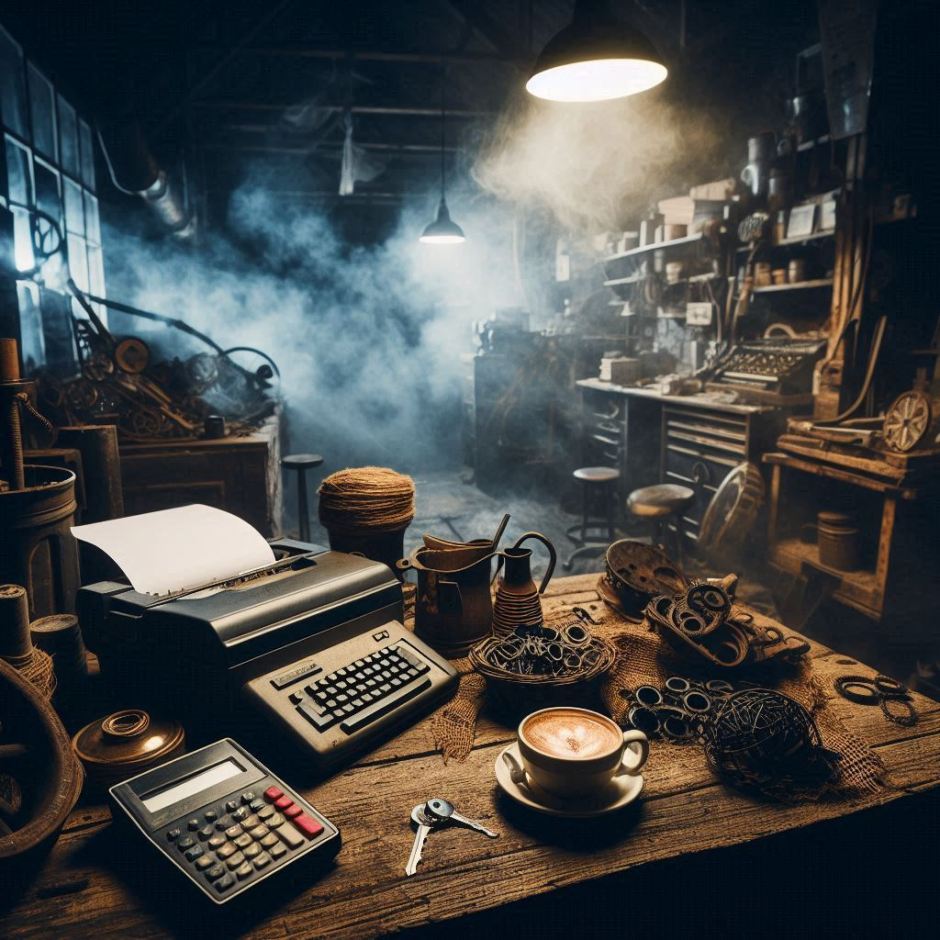
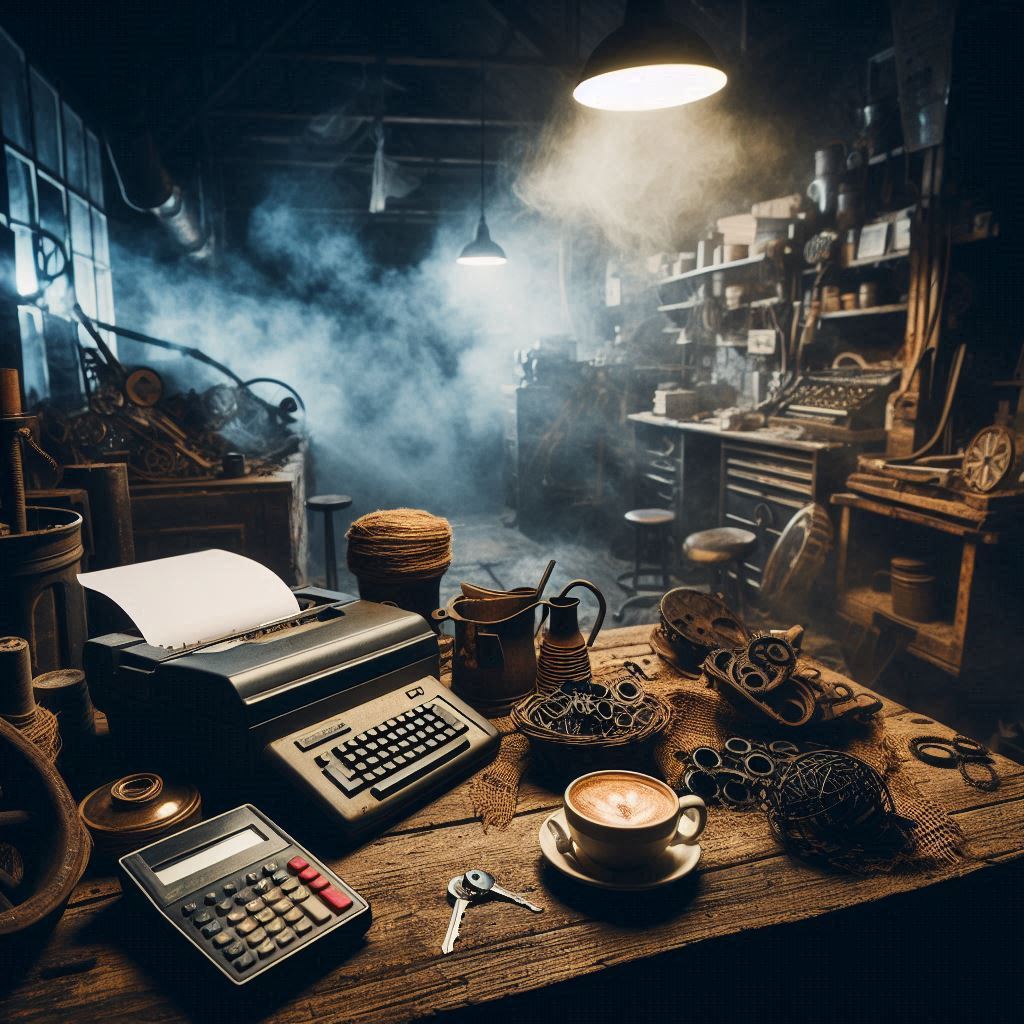
Image – Bing Image creator, a creepy workshop

From the Archives – A Short Story

Mortuary Remains

The skull was the colour of a tea stain. Elsa cupped it, in the palm of her hands and peered into the sunken eye orbits which leered unseeingly back at her. Behind her Hattie giggled, ‘She has better teeth than I do!’

Elsa couldn’t help but agree, the five-thousand-year-old skull had surprisingly good teeth. No stains, very little wear and a complete set to boot. And it wasn’t just the teeth, the rest of the skull was very well preserved.

‘She isn’t using them now, maybe you could borrow them,’ she replied as she passed the skull to the teenage boy standing next to her who was clearly a little too excited to be handling such precious remains.

Their tour guide had overheard their conversation. ‘Yes, we believe this individual was someone of high social status, which is why her teeth are so strikingly pristine.’

‘I thought the Neolithic diet meant that most people had poor teeth. Something to do with how they ground their grains,’ Elsa replied trying to sound casual and not to curious about the teeth. She knew this to be a fact, she was after all an archaeologist, but she didn’t want to make their tour guide feel uncomfortable – he was clearly doing his best.

He frowned at her and there was a cool glint in his eyes as he reassessed her from under his wild eyebrows.

‘Well, we believe that several of the individuals buried here come from the upper echelons of society. As we have a fair few skeletons in near pristine condition. Their bones tell us that they did no hard labour and that they enjoyed a good diet.’

Elsa wanted to push him on this. The Tomb of the Seals was a remote and desolate place and five thousand years ago it would have been much the same. Unfavourable farming conditions, poor climate and wild weather stirred up by the surrounding North Sea. Most people here would have lived hard and short lives. Indeed, that was still the case, their tour guide, a local farmer who had uncovered the tomb was evidence of that. He was roughly worn and stunted as if perpetually shrinking from a strong wind.

‘How many bodies did you say there were?’ asked the teenage lad. His voice quivered as he spoke, and Elsa rolled her eyes at the emotion in his voice. He was clutching the skull tightly in one hand whilst running the fingers of the other up and down the nasal bone, like he was petting a dog.   

‘During initial excavations we uncovered three hundred and twenty-four individuals. They were interred here over a period of eight hundred years. After Storm Quint we found various other remains, though not the cairn they came from. It was swept out to sea, but the bones, they found their way back to shore.’ Their guide nodded at the skull with the fine set of pearly whites. ‘She was among those. We only have her skull; it was found by a dog walker last summer.’

The tour ended with their guides wife bringing them cups of instant coffee and stale custard creams. As the other visitors milled around the car park, Elsa, under the pretence of needing to relieve herself snuck away. She wanted another look at the skeletons, her professional interest had been piqued. Something just wasn’t right.

She slipped into the old stone byer from which their guide had brought out the boxed remains. It reeked, the smell was so pungent she half expected to trip over a cow or a pig. This wasn’t a sterile environment suitable for storing human remains.

At the back of the byer, several heat lamps hung over some large stone troughs. A strange clicking sound, like thousands of tiny teeth or feet scuttling emanated from the troughs. Covering her nose, she approached, her nerves tingled, her skin crept, every instinct told Elsa to flee, but she didn’t. Instead, she peered into the nearest trough.

Thousands of shiny beetles scuttled and scurried, rived and swarmed under the lamps. What were they? She leant closer, staring at them, her stomach twisting in revulsion. She gagged and cheap instant coffee surged up her throat, which she swallowed down. The mass of insects separated for a second, like peeling skin, revealing the puckered and ruined face of the teenage boy who had asked about the skeletons. They were making quick work of his flesh, stripping it from his bones, his eyes were already gone, and his nose was just gristle.

Behind her the byer door opened. She spun round and there framed upon the threshold stood the tour guide. He smiled at her sadly.

‘Shouldn’t be putting our noses where they don’t belong,’ he sighed. Then he closed the door and turned the key in the latch locking them in the gloom together.

© Juliet Robinson 2023, all rights reserved

A Short Story

Though it probably isn’t obvious the following short story was inspired by Jack Schaefer’s book Shane. It was written for a workshop, the requirements being it had to include the quote …

“I leave you, to go the road we all must go. The road I would choose, if only I could, is the other.”

Which comes from Murasaki Shikibu’s, The Tale of Genji https://www.goodreads.com/book/show/7042.The_Tale_of_Genji a book I admit I haven’t read. The piece also had to be under 800 words. I chopped the quote up and played with it to make it better fit the story I wanted to tell. I had planned to return to this story, but as of yet I haven’t managed to do anything further with it.

Saquin Point

We came late to Saquin Point. Not a bad thing, for if we had been early or indeed on time, I wouldn’t be here to reflect upon what we found. The fire must have died before we passed over the range that separated the town from the Shifting Plains. So, we saw no tell-tale plume of smoke. It was around midday, so likewise we didn’t note an absence of lights. From our vantage point, the town was just a smudge on the horizon.

The first hint of anything untoward came as we passed an outer lying farm, it was mechanised so it wasn’t unusual not to see a soul, but it was odd that the large machines which tended the crops stood idle. Solomon who was taking point radioed the convoy.

‘Eyes right guys,’ there was a tightness to his usually relaxed drawl.

I glanced at the field and spotted what he was referring to, in large black letters someone had scribed on the side of a disabled piece of machinery.

The Gods love Chaos

We debated who the artist might have been as we continued down the road. I suspected it wasn’t the handy work of bored teenagers, but as things were it didn’t really give me cause for concern. Solomon and Nessa, however, were both spooked by the graffiti.

A mob of barking dogs greeted us at the edge of town. We stopped, puzzled by the pack and they distracted us, preventing us from properly taking in our surroundings. I didn’t note the lack of vehicles, I didn’t consider the absence of people or the silence. It was Maya who woke us up to the oddity of the situation, she tossed a half-eaten apple at the closest dog and pulled the pistol she wore on her hip.

I thought she was going to shoot the dog and snapped at her to leave the thing alone. She threw me a withering look.

‘Catch up Bryan.’

I finally took in the ghost town, the silence, and the faint smell of smoke. We left Nessa and Burke to watch the convoy and proceeded on foot, slinking from building to building, guns in our hands. We can handle ourselves; you don’t travel the highways with valuable cargo if you can’t, but still I felt uneasy and I kept thinking back to the message in the field.

As we approached the town centre, signs of violence started to appear. Bullet holes splashed along a wall, burnt buildings, looted stores, an overturned electric wagon and dried blood on the pavement.

The remains of a huge bonfire stained the town square, where once a baobab tree brought all the way from earth had grown. More words had been painted here, encircling the ashes.

The road I would choose, if only I could, is the other

We searched what was left of the pyre. I did so with my heart in my mouth, expecting to find charred remains, but nobody had been burnt in the flames. Thoroughly unnerved we stood in a clump as I checked in with the convoy, but only static answered my hail. Ashen faced, Maya started to talk, but she was cut off by the blaring of a horn, to be precise the airhorn from Solomon’s rig. Its shrill scream came from the opposite side of town, not from the Shifting Plains Road, where we had left the convoy.

Now we moved quickly, rushing through the streets, the horn crying constantly. At the edge of town, we found more graffiti, this time on the side of the school.

I leave you, to go the road we all must go

The horn reduced to a faded ringing in my ears, as I studied the words – did I want to understand what the scribe was saying? A loud retching sound drew me back. It was Maya emptying her guts over her worn boots. Beyond her Solomon was running, pounding down the middle of the road. In the distance, I could see his rig, it sat blocking the highway. I was about to follow when my brain caught up and I properly took in my surrounds. The poles that flanked the road, and which initially I had dismissed as being related to some construction project – the things that hung upon them, not things, people. The people of Saquin Point, they lined the road that led out of town, their throats slit, their eyes gouged out, their hands and feet hacked off.

I started to run, chasing Solomon down the road, refusing to look at the grim and silent honour guard, as I rushed past them. I caught up with Solomon moments after he silence the horn. He tumbled from the vehicle cab, his face a mask. ‘No Nessa, no Burke,’ he choked.

In blood on the side of his truck someone had carefully written,

Which road will you choose?

© Juliet Robinson 2023, all rights reserved