The Bonnie Lass

I went to the bathroom and threw some water on my face, combed my hair. If I could only comb that face, I thought. I snorted, better still comb the tangles from my life, but no, things don’t work like that do they, no easy fixes. I paused before opening the bathroom door, tried to give myself a pep talk, but it didn’t work. So instead, I just forged ahead.

There was more smoke in the corridor now. Not really a surprise. The sprinkler system was doing its best, but it was older than The Bonnie Lass, having been stripped from a drifting trawler twelve years hence. I held my hand out, let the smoke-stained water fall upon my palm. What does it taste like I wondered, sea water mixed with smoke, there had been whiskies like that. I licked my palm, the coarse skin tickled my tongue, but the water tasted nothing like my memories of whisky, it was bitter, with a hint of engine oil.

We had sealed the balk heads. The fire should have been contained. The plan had been to let it burn itself out. The Bonnie Lass is a big ship, one of the largest still out on the waters, a fire in the crew quarters was manageable.

I climbed up to the bridge. William and Fritz were arguing in low voices but fell silent as I approached. William seldom lost his temper, and Fritz whilst impetuous didn’t often challenge the captain.

‘Elizabeth,’ William smiled. But I know the man well enough to see beyond the curve of his lips, ‘How fare the rest of the crew?’

How does he think they are doing? Does he imagine their making the best of the situation? Should I tell him that as I passed the crew galley I saw Francis and Juno twisted together in the pursuit of carnal needs they hadn’t explored before. What about poor Jenny who had hung herself. Could I explain Turk’s painting, how he was throwing colour as if to create a universe into which he could flee. Did I need to say that Jack was sitting out on the bow humming a piece of music I dimly recalled from my childhood, ‘My bonnie lies over the ocean, my bonnie lies over the sea, hmmm hmm, hmm hmm.’  What did William want me to say.

Fritz did the talking for me, with his fists. His huge right paw slammed into William’s face, swiftly followed by his left. William blinked, his face paled, and he crumpled to the floor. Fritz turned to me, waiting for my reaction, but I gave him none. I said nothing and I did nothing as he hoisted William’s feet and dragged the fallen captain from the wheelhouse. I crossed the boards and stood at the helm, took in the view from the bridge’s windows. Smoke billowed from the ship; the fire had not been contained. The Bonnie Lass shuddered as a blast rolled through her, the engine rooms had succumbed. The lights flickered, the engines stalled and just before the power went out, I set a course.

Twenty-eight years I had been aboard The Bonnie Lass, most of them hard, but we’d made a living. We’d trawled for salvage, we harvested drifting vessels, we’d once seen a floating house with a family of cats living aboard it. I patted the helm, the ship owed us nothing, we were good.

I passed Fritz as I climbed to Monkey Island, he was fishing, though no line fed his rod. I watched as he reeled in his imagined thread, checked a hook that didn’t exist, rebaited it, then cast for the horizon. I didn’t ask where William was.

I settled against the radar mast, which had been stripped of its paint by harsh winds, biting waves and time. The Bonnie Lass had navigated it all, but this was her final whorl. From up here the smoke that belched from her ravaged body seemed a shroud. The ocean was a stilled stage, not a wave washed its boards, no wind pulled at the smoke, even the cries and groans of the dying ship were muted.

It was slow. Drawn out. Deliberate. Water began to boil at the stern, the hungry bite of the ocean taking its due. The Bonnie Lass didn’t fight it; with the grace of a diving bird, she tucked her nose and began her descent. There was no crashing roar, just a deepening silence. It was harder now to lean against the radar, the inexorable pull of the ocean’s maw threatened to topple me from my perch. I wedged my foot against the rails and kept my seat. The grey of the ocean was rising to meet me. I thought of the cats on the floating house and wondered where the waves would take them.

© Juliet Robinsons, all rights reserved 2025
Dinner Guests

‘I’m going to check on lunch.’ Nancy smiled, though Robin who knew her like the back of his hand saw that it didn’t turn the corners of her mouth.

She headed to the dining room, wishing she had never quit smoking. A caterer was putting the final touches to the elaborately set table. How had she become the overseer of such dinners.

‘All ready?’ She asked, in what she hoped was a crisp and calm voice.

‘All set.’

Returning to drawing room she tried to catch her husband’s eye, but he was engrossed in Ileana, possibly her conversation, she thought tartly. Instead, she cleared her throat and declared dinner ready.

Drinks were poured though Ileana refused, asking for sparkling water. The starters arrived, and they were exquisite.

Robin sat next to his latest girlfriend Jade a younger variant of the last three. She was smiling at him raptly, twirling a finger through her hair though he kept trying to drag others into their conversation. Casting his eye towards Nancy every so often she thought perhaps pleadingly, but really, he had brought this on himself.

Torin sat between Ileana and Nancy; his shoulder slightly turned from his wife and his attention on Ileana. She laughed at his jokes, but kept glancing towards Nancy, almost placatingly.

‘Torin says you used paint.’ Ileana beamed.

Nancy took a large drink of white wine and looked at the woman. She could see the appeal, and at least this one was intelligent.

‘Yes, I had a studio not far from your new gallery. The southside was a little different back then.’

Torin turned to his wife. ‘Ha! More than a little, I thought you would be kidnapped. You know she really was talented but along came Alexander.’

She. Was. Nancy’s nostrils flare.

‘She still is,’ Robin corrected. ‘Stick your head round the door on the right before the bathroom, it is filled with her recent work.’

Torin sat up straighter and shot a look at Robin.

‘You’ve been allowed in the studio.’

‘Just once, back in January when you and Ileana were setting up the itinerant exhibit in Amsterdam.’

A tension vibrated round the table, four sets of eyes avoided each other, the other two cast round in amusement and confusion.

Jade changed the conversation though Nancy didn’t think it was because she had picked up on the other diner’s sudden rigidity.

‘I adore children, I would love to be a stay-at-home mother.’ She was looking directly at Robin, but he refused to notice.

Michael giggled loudly. ‘I hate children, and I need a smoke, please excuse me. I trust I have time between courses?’

He stood not waiting for a response.

‘Let me show you to the terrace.’ Nancy volunteered.

Outside he offered her a cigarette, but she declined.

‘Why am I here?’ He asked.

‘Ileana was meant to be bringing her assistant, young, Italian, with an arse you can bounce off a wall. He’s possibly your type.’

‘You’re trying to partner me off? Spare me. Relationships are for those who have given up on life.’

Nancy sighed, reached over, and snatched the cigarette from his hand. She leaned back against the rail, enjoying a long drag she held it in her lungs for a long time, savouring the chemical heat. As she exhaled, she felt herself wilt and Michael put his arm around her shoulder. She leaned into her friend and not for the first time that she and he could be something more to each other, but neither’s sex quickened the others pulse.

The second course arrived, swordfish in a lemon and garlic sauce.

‘So, Ileana, when does the new gallery open?’ Robin asked.

‘Next month in theory, but Torin keeps insisting that the space isn’t right for his new pieces.’ Her eyes lingered on the artist in question. They shared a smile.

Michael tried to kick Nancy under the table but missed and scuffed his foot up Robins leg. Robin glared at Michael, who tried to signal with his eyes that boot hadn’t been intended for him. Ileana continued unaware of the ocular bout and the glacial look Nancy had hurled at her.

‘I have never meet with an artist with such passion for the entirety of experience regarding their work. Torin is a purist, a talent, a perfectionist.’

Torin frown and waved as if to brush off Ileanas compliments and Nancy felt her eyebrows raise at this effect modesty.

‘No, its true!’ Ileana insisted.

Torin sat back languidly in his chair. ‘This collection is the peak of everything I have been working towards, my entire life. I am not apologising.’

The caterer started to clear the table; she paused at Ileana’s plate which was untouched unsure if she should take it.

‘I am sorry,’ Nancy said. ‘Don’t you like swordfish?’

Ileana fleetingly touched a gentle hand to her stomach, just for a second and Nancy may have been the only person who noticed.

‘It doesn’t seem to agree with me at the moment.’

© Juliet Robinson 2025, all rights reserved

Mind Burble

This piece was just an exercise in tension an attempt to keep its tone low.

A short walk and a long drop.

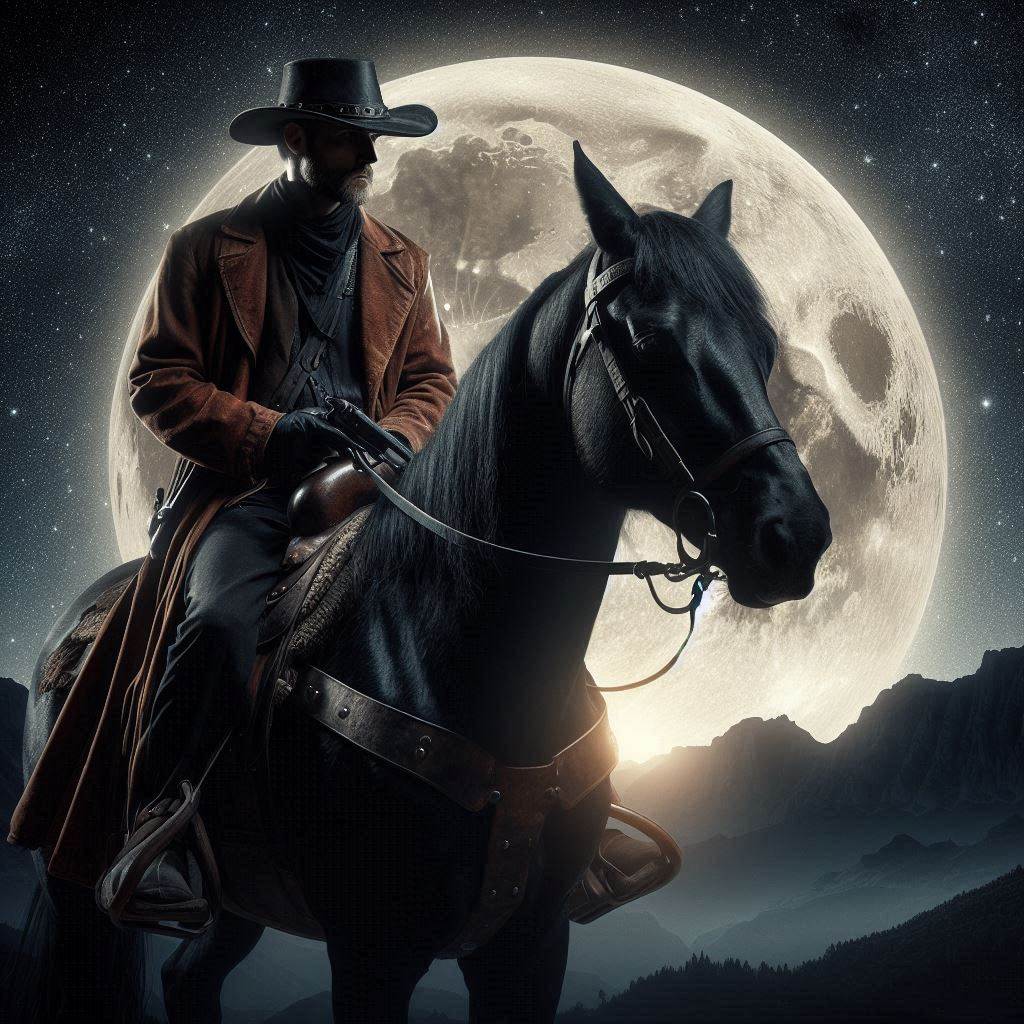
Image – Microsoft Bing Image Creator, 20th May 2025

‘Put on your boots, strap on your gun, come on let’s ride.’ Abner, always with a sense of the dramatic.

The posse crossed the border in darkness, horses blowing hard, my hands numb on the reins. We hit the snowy plains as the sun rose, its glare fierce on the white world, but it did nothing to warm me.

Round noon we reached the pass, where Decker and I rigged the cliffs with dynamite. We hid them best as we could, the train would have to slow here as the tracks make a steep curve, we didn’t want an attentive engineer spotting anything. Then all we had to do was wait.

Lopez, Red and Decker played cards, I saw to the horses and the twins Laird and Kit heated up some foul-tasting coffee. Abner, he sat apart and made notes in that book he keeps. A thinking man, or at least that’s what he wants us to believe. 

We heard the train long before we saw it, the shrill piping of her whistle and the chug of her engine reverberating off canyon walls. A ripple of excitement flowed through the posse. Decker hurried to the detonator, the fire was kicked out, I brought the horses up, girths were tightened, guns were checked and we mounted. Bravado and swagger were high, today would see a big pay out. The train below belonged to Arnold Wallace and our sources assured that a back dated payroll was onboard.

On Abner’s signal Decker blew the dynamite. The cliff walls heaved, as if taking a deep breath then blew outwards and tumbled onto the tracks. The whistle cried again and brakes screamed. All along the train windows fluttered open and guards poked their heads out.

Kit and Laird opened fire, their Winchesters cracking loudly as they picked off guards and enginemen. Then we were away, hooves kicking up muck and rocks as we bore down on the train. The plan was simple. Abner and I would take the armoured car, we had bolt cutters and dynamite. While we did this the others would subdue the guards and rob the passengers.

Things went smoothly, we met less resistance than expected. Far less. The vault was as promised, a treasure trove. Alongside the payroll we picked up ten gold bars. Abner strutted as if he had laid them himself, while I wondered about the ease of the robbery.

Lopez’s horse dragging his lifeless body along the tracks alerted us to the arrival of the Pinkertons. For a moment the world stilled, then they were on us, guns firing.

A set up and we had fallen for it.

Saddlebags bulging, we scrambled back to our mounts and flew. Our horses weren’t fresh, they didn’t have the legs for a race. Decker chose to face the Pinkertons. Lairds’ mare went down and Kit turned to help his brother. Red, we lost in the woods. Abner and I raced on. Not far from the border, with freedom in sight he turned, aimed his colt at my horse and shot her out from under me.

Down we went, a tumbling mass of horse and rider, a flurry of bank notes, snow, and dirt. I watched Abner cross the river and disappear.

The Pinkertons brought me in. They gave me a choice, a short walk and a long drop, or information on Abner. I ratted my brother out; I spilled my guts.

Red danced on the line while I waited to see if my information brought Abner in. I wanted to live, but my betraying talk proved worthless.

On a fine spring morning I was taken to the gallows, a crowd had gathered to watch me drop, the mayor and other dignitaries. Just before the gallows man dragged a sack over my head a well-dressed gentleman who stood next to the mayor doffed his hat to me and smiled with satisfaction, Abner.  

© Juliet Robinson 2025, all rights reserved

Mind Burble

This is an old piece. I love a good Western, but had never attempted one. There was a limit of seven hundred words for this piece, so it was a bit of a squeeze!

Lang may yer lum reek

‘Time is priceless, but its free. You can’t own it, you can us it. You can spend it. But you can’t keep it. Once you’ve lost it you can never get it back.’

‘That’s good. A pseudo philosopher once took a shit here. Pass some bog roll.’

Fiona’s hand appears under the stall wall, she’s wearing emerald, green nail polish, which is heavily chipped, I take the sandpaper she offers.

‘Thanks – Call Gregs ma for a good time.’

‘Is there a number?’ Fiona asks.

‘Several.’

‘Don’t drink water, fish have sex in it.’

‘Solid advice.’

The toilet next door flushes.

‘You ladies do know this is gents, right?’ Callum asks.

‘Wash your hands!’ Fiona shouts.

The tap runs and a second later Fiona shrieks. By now I am finished and am hiking up my tights, which have twisted something rotten.

‘Callum Brown!’ Fiona roars. ‘I can’t believe you tee-pee’d me!’

‘Ha!’ Callum snorts.

I unlock my cubicle and stagger out, somehow in the last few minutes I seem to have gotten drunker – the inebriating stench of the men’s toilets. Callum standing at the sink wetting another handful of loo roll.

‘I wouldn’t,’ I warn him.

‘I’ll take my chances.’

I shake my head at his stupidity, Fiona is a force to be reckoned with. After washing my hands and give myself the once over. My eyeliner is halfway down my cheeks, so I push it back up, and smear some concealer over the grey stains its left behind. Callum launches his second barrage of missiles at Fiona, who screams. She is going to kill him.

Her cubicle door flies open, and she stands with her head lowered, eyes ablaze, like a bull about to charge, she’s even kicked off her heels, they lie discarded on the floor. Given the state of the tiles this was either very brave or very foolish of her.

‘Shit!’ Callum shouts and he takes off.

Fiona’s after him like a hound. ‘I’m telling mum!’ she brays.

What is about family gatherings that causes us to revert back to our formative years, I wonder. Perhaps the intellectual who wrote that nonsense about time might be able to answer that question. I leave the bathroom just as Uncle Angus tries to enter it, he looks at me in confusion, so I tell him that this is the ladies.

‘Oh, sorry.’ He wanders down the hall to the actual women’s, stops in front of the door then turns back to me, ‘Una! You’ll get me arrested for being some sort of creep!’

Laughing I make my way back into the packed bar. I know nearly everyone here, villagers, friends and family. The air is heavy with the warmth of our crush and thick with conversation. I can hear Fiona and Callum over all of this, they are still arguing, but unlike when we were young, neither of them is crying and no punches have been thrown. I force my way through to the bar and try to get the young server’s attention, but before I can Betty Tolworth starts bellowing for silence. I glance at the clock, surely it’s not that late? But right enough it’s 11:50. When nobody responds Betty smiles at me, picks up the large metal bell she keeps behind the bar and is rumoured to have once used to break up a fight.

‘Would you like the honour?’ she asks.

Taken aback by this gesture of trust and the offering of such power, I smile devilishly, and snatch up the bell eagerly.

‘On you go,’ she says.

With a heady sense of authority, I start swinging my arm and the bells tolling silences the White Harts custodians (even Callum and Fiona). Carried away by all of this I find myself shouting, ‘Bring out your dead.’

‘When you’re quite finished Una,’ Betty says. She’s standing arms folded and eyebrow raised, but she’s smiling. ‘You all know what that means! Out! All of you! Every last one of you.’

‘What about Brian?’ Someone asks. Brain is fast asleep, propped up at the far end of the bar.

‘I’ll deal with Brain,’ Betty says ominously.

And with that we start making our way out, there’s a scrummage at the door as people pull on coats, search for cigarettes and make sure they have everyone they arrived with. Its cold outside, it’s been a harsh December, even the river has frozen over. We crowd into the small car park like a milling herd of sheep. I spot Duncan and Isles who are huddled smoking by the beer garden gate and make my way over to them, ‘Cuz!’ Duncan greets me as he taps out a cigarette for me, I’m drunk enough to take it, and regret it almost instantly when the smoke hits my throat and the world spins.

The sound of feet rushing over gravel announces Callum’s arrival. He’s flushed and looks pleased with himself, I assume because he’s managed to get the better of his sister. The rest of our clan slowly gathers as we stamp our feet and huddle against the cold. Uncle Angus stinks of whisky, his cheeks are furnace red and he sways on his feet like he’s moving to a tune only he can hear. Fiona managed to sneak two pints out with her, and we pass these between us as we wait.

Behind us the church bell begins to toll, the crowd counts along with the strikes, ‘Ten, nine, eight, seven, six, five, four, three, two, one! Happy New Year!!’ we bellow as one.

Inside the White Hart the piano starts up – Old Lang Syne. I hear the back door to the pub bang open and Betty calls out, ‘Friends and family only.’

And at Hogmanay everyone is family or a friend.

© Juliet Robinson, all rights reserved 2025

Mind Burble

I am writing at the moment, just slowly and mainly my focus is on editing. I hate editing, and I really struggle to get on with it.
This short piece was written for a workshop. The quote ‘Time is priceless, but its free. You can’t own it, you can us it. You can spend it. But you can’t keep it. Once you’ve lost it you can never get it back.’ – comes from Harvey MacKay and was the prompt we were set for the workshop.

The title – Lang may yer lum reek, is a Scottish new years greeting, or indeed Hogmanay greeting and is essentially a blessing. Lang means long, yer means your and a lum is a chimney. Thus it means may you never be without fuel for your fire, or indeed warmth, health and good fortune.

A Job for Life

‘I woke at six. I need no alarm clock. I was already comprehensively alarmed.’
Silence followed Murray’s smug words and he shot his audience a peevish look.

Only Owlish seemed to be listening, he blinked two large eyes and shuffled his chicken wire wings. Murray pursed his lips and decided to help them get to the punchline. He waved his left arm in the air and pulled his sleeved down, exposing raw, puckered skin, and an ugly rend which dominated most of the ruined limb. Nestled amongst the pus and tendons was a green Bakelite alarm clock, its second hand had fallen off, but the hours and minutes still ticked.

‘Comprehensively alarmed.’ He shoggled the limb and blood started to seep from the tender flesh.

Owlish turned his head away, the whole hundred and eighty degrees.

‘Clearly I’m only one whose had their coffee this morning!’ Murray grumbled. He picked up a spanner and wiped dried blood from its head. ‘Speaking of coffee – De’Longhi?’ the dark corners of the shed shuffled, but nobody came forward. ‘De-Loooonnnghiiiiiii.’ 

A trundle of wheels answered Murrays call as finally De’Longhi rolled forth. Her feet had been replaced with office chair wheels, her lovely long legs curved upwards, to her hips which now supported a rusty coffee machine, upon which her heavy bosom rested nestled amongst the stacks of cups.

‘Cappuccino,’ Murray demanded. ‘Anyone else?’ No reply.

De’Longhi smiled weakly and started his order. Her gel nails were chipped and as she steamed the milk flakes of pink tumbled into the froth, where they spun and twisted.

‘You do make a fine coffee,’ Murray offered her rare praise. ‘Shame you had to go on maternity leave, the office wasn’t the same without you. I told you when you started, we are a family. You don’t walk away from your first family.’ He glanced down at her wheels and smirked.

De’Longhi poured the espresso and topped it with steamed milk and froth. Her mottled hands were shaking and a maggot fell from her flesh and plopped into the beverage. She started to shake, cups clattering.

‘Extra protein,’ Murray smiled, his dry lips stretching thin over stained teeth as he took the cup. As De’Longhi retreated and he slapped her behind playfully.

Owlish hooted reproachfully.

‘What?’ Silence. ‘Yeah I thought so. No backbone, you were a weak and pathetic security guard and whilst you’ve changed a great deal you’re still pitiful.’

He sipped his coffee for a moment, then pulled the sheets from the workbench. Gary the intern lay there, his mouth bound with gaffer tape. Next to him was the office fax machine, the one that only he had been able to work, when Gary left his placement, returning to college the damned thing had given up.

Murray ran a finger along the machine, ‘You weren’t the only one who missed him. But he’s here now.’ He smiled at Gary, ‘Aren’t you.’ The lads eyes bulged and he strained at the telephone cords binding his limbs. ‘No, no my dear boy don’t fret, this is a job for life. Think of it, lifelong security, not many companies offer that anymore.’

Murray turned away to consider his sketched-out plans, he had been careful to consult with the fax machines manual while planning Gary’s premotion. Tinkering was a fine art you could never be too careful.

‘Tell me Gary, where do you see yourself in ten years’ time?’ he asked wondering if he had left enough room for upgrades, what if the office went fully digital, switched to email entirely. ‘Do you know how to send and receive emails? You’re young, is that something you’ve learnt at your fancy college?’ Murray turned back to the youth, but Gary wasn’t on the workbench anymore, nor was the fax machine.

‘Gary?’

A flash of white and something heavy smashed into Murrays face. The fax machine. Gary swung again, this time striking Murray in the stomach.

‘I quit!’ Gary roared as Murray slumped to the ground. He turned and rushed towards the door where he struggled with the bolts. Just as he pulled the last one free Owlish swept in, leaping from the shelf in a flurry of wire and feathers. It didn’t take him long to subdue the youth. Murray sat up, shaking his head sadly at Gary. But he quickly brightened and smiled at Owlish, ‘Somebody’s getting their bonus this year.’

© Juliet Robinson, 2024 all rights reserved. 

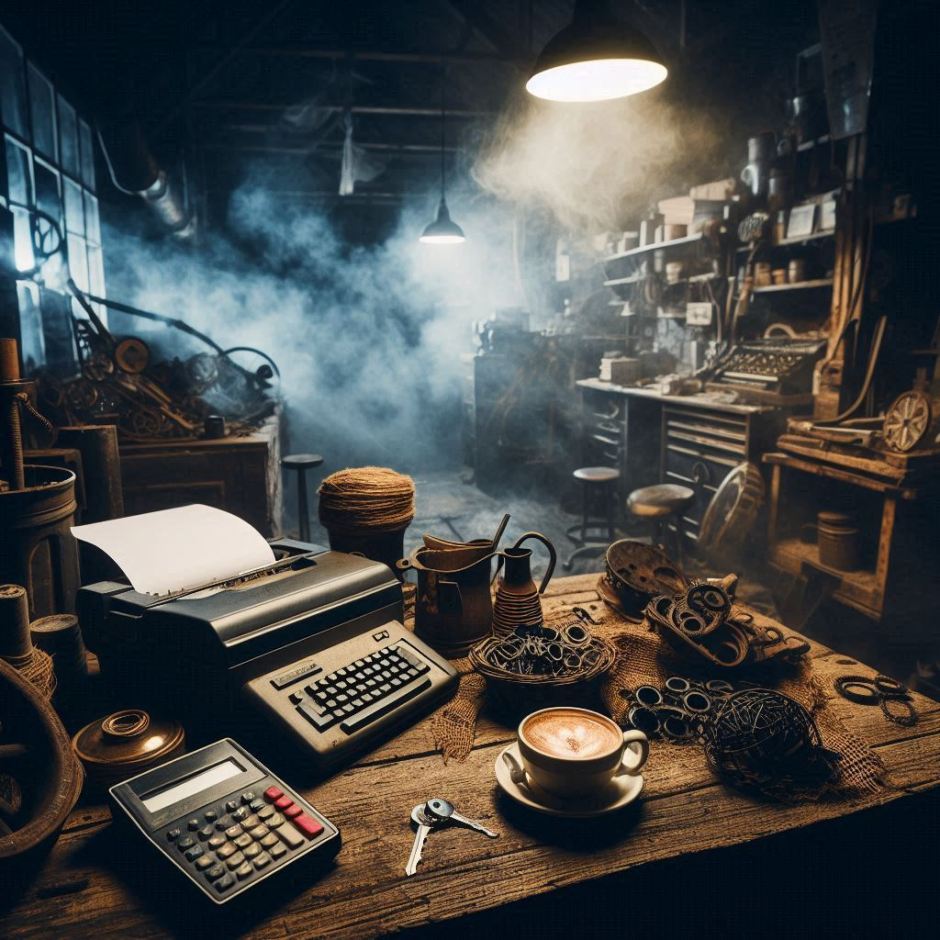
Image – Bing Image creator, a creepy workshop

That Time in the Jungle with ‘Tom Cruise’

The boat lies low in the shallow water, so the hull scrapes over rocks and sticks in the silty mud, we climb out when this happens and push. The first few times I take off my boots, and then put them back on lacing them carefully, but soon I stop lacing them and then I don’t bother to put them back on. Eventually we abandon the boat, and instead we walk upriver alongside it, pushing it against the sluggish current.

Despite the lack of rain, the humidity hasn’t gone anywhere. When we first arrived all
those months ago it was like walking into the hothouses at the botanical gardens. I felt wet and shiny the whole time, and it smelt like a tropical fish tank. But we’ve acclimatized, I’m used to the sheen of sweat on my face and my t-shirt sticking to my back. And the smell, I’m used to that also, rot and decay (which are really the scents of growth and life), at first it had stuck at the back of my throat, and it was hard to swallow, but now it isn’t even there.

We’ve been traveling for four days – one short jungle flight, where there were more
chickens on the plane than people, a day walking along dusty old military roads, a spot of hitch hiking and now the river. Our guide, who told us to call him Tom Cruise, says his sister has a restaurant in the next village where we can spend the night. Will negotiated a good price for the boat, so we can afford a night of accommodation. I’m looking forward to not sleeping in a hammock strung between two trees in the forest. I’m afraid of the dark and there are few places darker than the rain forest at night. And the noise! The sounds of the forest are so alien I fall asleep sure I won’t wake in the morning, I am convinced a monster will kill me in the night.

Its late when we arrive at the village, which is little more than a few longhouses crowded
on the riverbank. A rust brown dog lies in a pile of fishing nets, it stirs as we unload the
boat and comes over to see if we have any food. Tom Cruise tries to shoe it away, but I tell him off and in apology offer the dog a chunk of the tracker bar I have just opened.

Dusk falls quickly here and it’s upon us before we have even shouldered our packs. Tom Cruise is eager to get to his sisters, he buzzes around hurrying us, though when we insist on having a smoke before we leave, he forgets his hurry and bums a rollie. We smoke a lot here – it keeps the insects away, but also because it’s a comfort and a luxury. Two things which don’t otherwise exist in the jungles of Borneo.

Tom Cruise gathers our cigarette butts, pockets them, and then he is off, leading us along
the trail which wind between the houses. There are no roads here and no village boundary, the forest just starts at the edge of some hog pens. Tom Cruise pushes forwards and the jungle swallows him. We follow him, no questions asked, though it briefly occurs to me that he could be about to rob and murder us, but this doesn’t really worry me as much as it should.

It turns out his sister’s restaurant is a long way into the forest. We stumble through the
thick undergrowth, and I laugh when Will accidentally kicks up a fire ants’ nest. I shouldn’t it really hurts when those things set about you, but it’s funny listening to him shriek and thrash about in the dark.

After a while we find ourselves on a well-worn path which is a welcome relief and then there are lights ahead of us and Tom Cruise calls out, ‘Hungry?’

His sister’s restaurant is a funny place, its location for a start is strange, out here in the
forest a good hours walk from the village. It’s a large two-story longhouse on stilts, too big for one family and it doesn’t look like a restaurant. We troop in and it takes a moment for my eyes to adjust to the bright glare of the bare bulbs which light the place. A bench table sits in the middle of the hall and a balcony runs around the upper level, there are doors up there – lots of them and scantily clad women hang over the rails peering down at us.

‘A restaurant,’ I raise an eyebrow at Will.

His face is sunset red, and he starts to stammer a reply, but I ignore him and stalk towards the bar at the back of the room. The smell of cooking meat stirs my stomach, and a warm beer will go nicely with that. A roof is a roof, if I get fed and I don’t have to worry about forest monsters for a night I don’t care if Tom Cruise’s sister’s restaurant is really a brothel.

© Juliet Robinson 2024, all rights reserved

My own picture a river in Borneo

Mind Burble

This short piece is based on a trip I took many thousands of years ago to Borneo. It was an amazing adventure filled with leeches (I hate them), dodgy stomachs, endless rainforest, climbing, hiking, living on beaches and being young. We would hire locals to take us out on long treks through the rainforest and to sites, often they would give themselves celebrity names. So yes, ‘Tom Cruise’ did take us to stay at his sisters brothel, the food was amazing and it was the first bed I think I had slept in for weeks. ‘Chandler Bing’ took us climbing and showed a cave burial site, in which his ancestors rested in. We had the pleasure to meet lots of amazing people who showed us their wonderful part of the world.

Honestly though none of this seems real anymore.

Protector

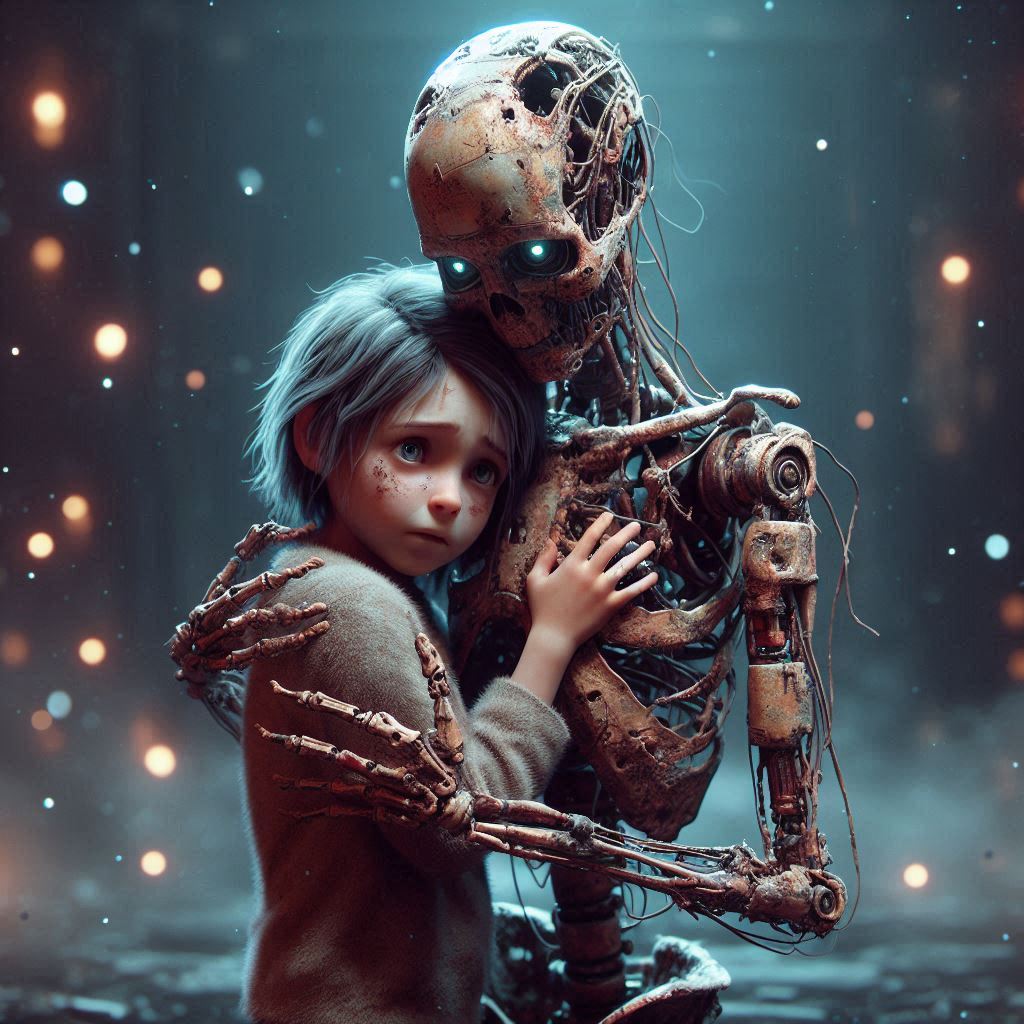
The child who has just thrown herself like a shield over a rotting synth causes me to pause. Forces me to see her. She lies draped upon the cowering machine and she glares at me. She’s scared, but defiant. I shift my rifle, making sure she can see its aimed at her. She takes a jagged breath but doesn’t move.

‘Step away from the synth.’ My voice is sterile and authoritative.

She shakes her head. She’s terrified, but she still doesn’t move.

‘I am here for the synth,’ I say. My gun doesn’t waver, but neither does this small half-starved human shield.

‘Not Polly.’

I stare at her from behind my visor. She’s shaking, her whole-body rattles, but she doesn’t
back down. She’s tiny, malnourished, no different from any other slum rat, except that she’s brave enough to defy me, she’s able to overrule the animal parts of her brain that are probably screaming for her to run, to flee into the twisting alleys that make up the Pritech Quarter.

I am used to people protesting when we come for the synths. But not like this – Who’s going to look after me now? How am I going to get work done around the store without it? That thing cost me a lot of money. Am I going to be compensated?

Polly, an odd and soft name for a synth.

There’s chatter over the comms, other patrol members reporting in, synths being brought
back to the convoy, and I am still standing here considering this street rat and her Polly. I
have a job to do, I have orders, not worth the trouble of not doing my duty, I need this job. I lower my rifle and pull my holstered stun pistol, aiming it at the child. I will use it, I would rather not, but I am here for the synth, and she is in my way.


‘You have till the count of five,’

She doesn’t blink.

‘One,’ I pause giving her chance, ‘two,’ another pause, ‘Thr …’

The synth moves. With practiced ease I holster my stunner, swing my rifle up and aim it
at the pair, not taking any chances. The synth gently curls a hand round the girl’s bony wrist, its missing fingers, the index and the pinkie and the synthetic epidermis on its hands looks rotten. It can’t rot, its not real, but this synth is old and that’s why I am here for it. Another virus, the work of yet another smart-arse hacker is doing the rounds. The older synths have less protection, so it struck them harder, for the most part its just affected their motor functions causing erratic twitching and immobility. But others the virus has had a more dramatic effect on, like the service synths at Sukara Sushi the virus managed to take full control of their systems, and it weaponised them. After attending that mess, I won’t be eating sushi anytime soon.

‘I will come with you Protector,’ the synth says.

Its voice is rasping and weary. It possesses a human like quality, the melancholic echoes
of a lifelong lived.

‘No!’ the girl wails. It’s the first time she’s let fear and panic take control. Her stick thin
legs scrabble for a purchase on the synth as it rises to its feet, a desperate attempt to hold on. ‘No, no, no!’ Her arms tighten around its neck. ‘Polly, please!’

The synth is now standing, the girl wrapped around it like a primate infant clinging to its
mother. (I have seen those in reruns of centuries old documentaries, visited them in the
artificial zoo.) With its full form unfolded, I can see the extent of its deterioration, the ravages which time have worked upon it. It’s an antique, a Mark Two, maybe even a relic from the Mark One era. How is this ancient machine still functioning? Its survived decades, perhaps even a century.

‘It will be ok. You will be ok,’ it assures the girl whose face is buried in its neck.
Slowly and with great care it starts to detach the child. Initially she resists, fighting this
removal with the same tenacious ferocity from earlier. But then as if a thread has snapped, a dam broken the fight goes out of her, her tiny body falls limp, the fierce spirit dissolving. Her surrender fractures something within me, a shard of empathy pieces the calloused armor of my rank and role. Protector, here to collect, to bring the hacked synths in for repurposing, stripping down, recycling.

My rifle is heavy. ‘I can’t do it,’ the words scrape against my throat.

With a shaky breath I lower my weapon. My mind races – scrub the data from my helmet
cam, I’ve done it before, but for lesser sins. It’s a gamble, I’ve a lot to lose, people depending on me. I turn my back on the pair, heading away from the heavy shadows of this alley, the synths voice follows me through the gloom.

‘Thank you, Protector.’

© Juliet Robinson 2024, all rights reserved

child and ancient synthetic robot – bing image creator

Dook

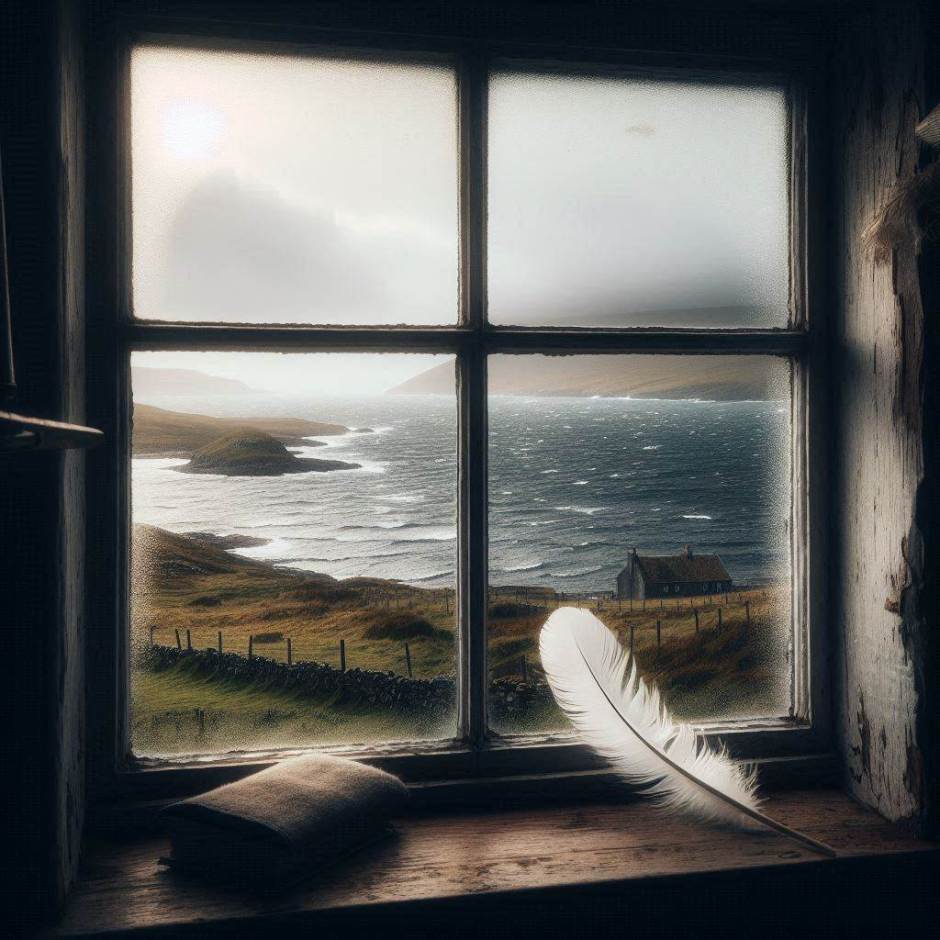
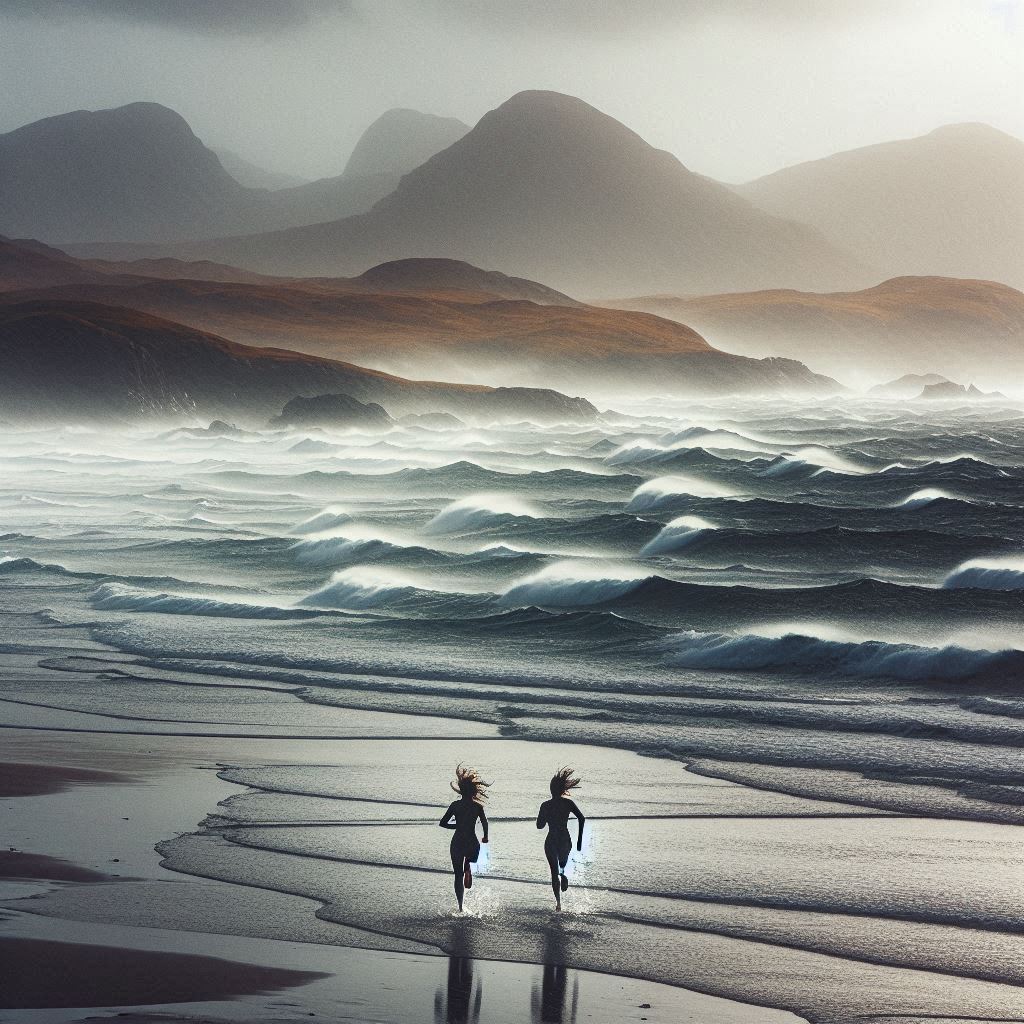
View from a crofts window looking out at the north sea, Bing Image Creator

I tried the window, but it wouldn’t budge. Painted shut. The room was stale. There was a scent swirling amongst the dust motes that I couldn’t quite pin down, feathers, old pillows. Whatever it was, it wasn’t pleasant. I peered out at the darkening sky, clouds where creeping in, soon I wouldn’t be able to see the hills across the water.

The bed was damp and unaired, the sheets clung to me, and a chill settled upon me. My stomach growled, I should have eaten on the ferry, but the food in the canteen had looked plastic, hardly appetising. And the rolling waves had done nothing to inspire hunger. I turned the light off and darkness swallowed me.

I dreamt I was flying a kite. I stood barefoot on the beach, the icy waves washed over my frozen feet, back and forth, back, and forth. I faced the ocean, but I could sense someone up on the dunes watching me, the creep of their eyes upon me. The wind tugged at the kite. Snatching it and snapping its line.

I woke as the red and yellow kite was swallowed by a towering cloud.

The room was still dank, and the funk of my sleep had done nothing to improve the smell. I pulled on the thick woolen jumper I had picked up in a charity shop while waiting for the ferry. It prickled my skin, but it was a barrier to the cold. The curtainless window revealed a dreary day, with heavy clouds. White horses raced over the waves and for a moment I thought I saw something breach, a fin, or a tail, but it was engulfed and lost from sight almost instantly.

Something fluttered by the window. I moved closer to the jack frosted panes of glass. It was a bird’s wing, the rest of the creature was a fetid mass, stuck to the rotting wood of the window frame, but its wing was flight ready. I watched it twist in the wind and remembered the kite.

Nobody was about downstairs, but the water in the kettle was still hot. I made myself a cup of tea, which I drank in a hurry. It sloshed in my empty stomach stirring a sense of nausea. I needed to eat something.

The fridge was empty except for some wilted celery, a crumb covered lump of butter and tub of chopped up bait. A search of the cupboards revealed various aged tins and a packet of half-eaten mince pies which were nearing their first birthday. I hate mince pies, but I don’t function when I’m hungry.

Picking pie from my molars with my tongue I wandered down to the beach. The wind turned my hair into a mess of writhing snakes, which whipped and snapped at my face. I could feel the pounding of the waves through the soles of my boots. I stood just out of their reach and watched as they threw themselves on the sand with frantic hunger.

I was hypnotised by their energy and didn’t hear Magda until she spoke, her words soft and warm in my ear, ‘Did you bring your wetsuit?’

I laughed, of course I hadn’t. No time for that, as soon as I had hung up the phone I was in the car, on the road, on my way here.

‘Only a fool would swim on a day like today,’ she concluded. But there is a challenge in her voice.

For a moment neither of us moved. Statue still. Runners poised at the starting line. Then I was a tangle of limbs, twisting, pulling, hurriedly ridding myself of my clothes. The bitter wind lanced through my exposed skin. Beside me Magda skipped on one leg as she tried to pull her foot free from her jeans. I gave her a shove and she fell bare arsed on the cold sand with a satisfying slap.

Then my sister and I are naked as we were when our mother pushed us out of the womb we once shared. I grin at Magda, and she returns my smile, for hers is mine and we run, full tilt into the wild ocean.

© Juliet Robinson 2024, all rights reserved

two wild swimmers on a Scottish Island – Bing Image Creator

Under the Apple Tree

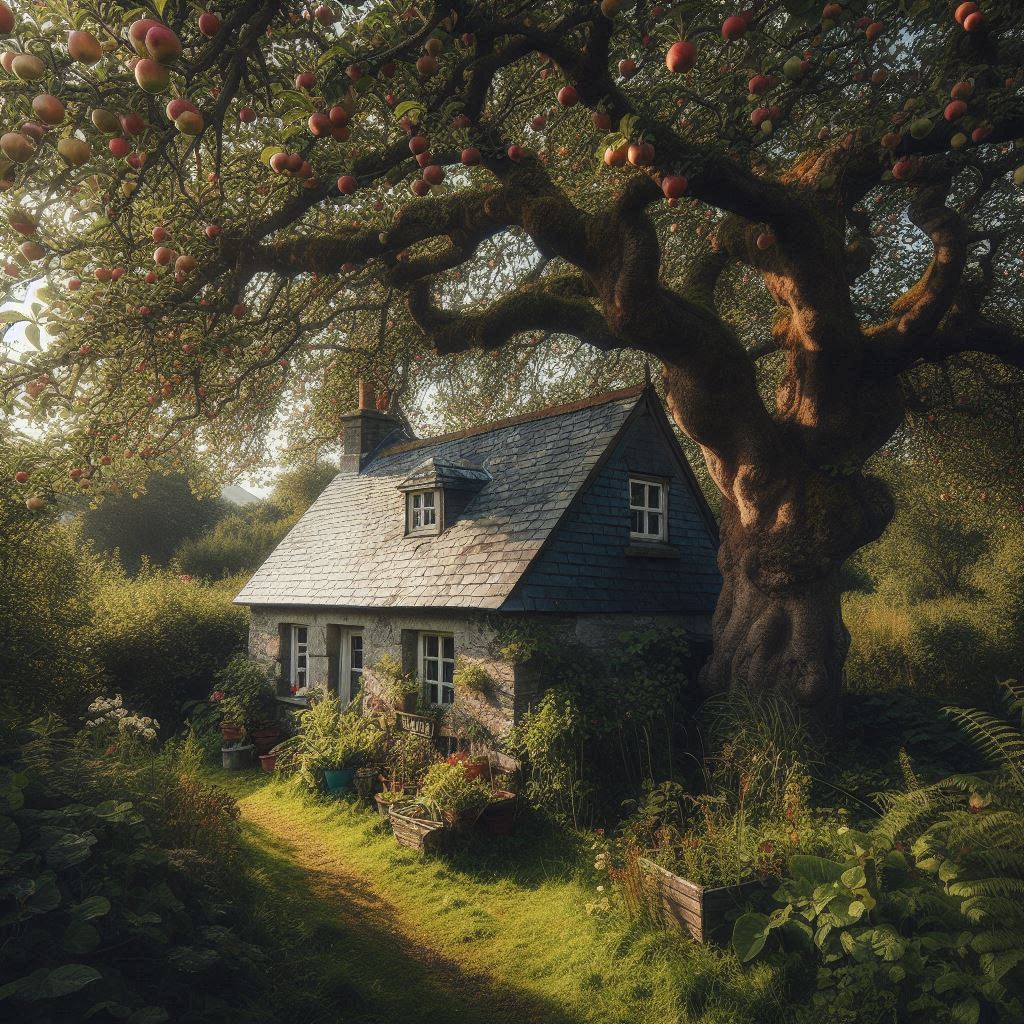
Image. “ramshackle cottage under a large apple tree,” image generated by Microsoft Bing Image Creator, June 17, 2024

Let me tell you about my mother. This morning when making coffee, the percolator boiled over and the smell of burnt coffee, the toasting bread, and the jam was like a conjuring. I wasn’t in my own home, in a rush, half-dressed and wondering why I hadn’t gone to bed earlier, and worrying about the school run, or work, or how I was to walk the dog and still have time to make lunch. I was young again, maybe five, though I could have been any other age between five and leaving home and I was in another kitchen.

My mother’s kitchen, with its low oak ceiling, stained from years of cooking, with the small window which was always covered in pots of parsley, chives, basil, rosemary and coriander all wilted and straining for the light. With the too much stuff piled around the counters, books, opened letters, chopping boards, half-drunk cups of coffee, the toaster that had never worked – sometimes burning the bread sometimes returning it with a mild tan but it was such a pretty colour that we kept it, the postcards peeling away from cupboard doors and the notes, little nippets of a thought, or a message from someone saying we needed milk.

In the house under the tree time was a funny thing, it was endless, all stretched out, and slow, not like the present where all it seems to do is hurtle along racing towards what I don’t know or perhaps I do know and I don’t like to think on it. Time is a trickster just like the devil supposedly is, or was, or isn’t depending on your beliefs.

My mother fell on the wrong side of time, or the devil if you would believe her mother who knew much of such matters and had solely given herself to the one god and his son, but it was my mother that the smells brought through time, or perhaps it was me who was cast back in time, either way not her mother.

My mother was late to be born, nearly a month, not the September baby she was meant to be but an October one. October the tenth month of the year, though it to is out of place or time, since originally it was the eighth month of the year, hence its name – ôctō. October, an autumn month full of fat trees, branches hanging with fruit, like the cooking apple tree which half swallowed our house and dropped swollen apples upon the roof when the wind was up, which it normally was and we half thought the ceiling would come down upon us, but the slate was strong and backed with oak so it never did.

My mother was too early for her own wedding and had time to think it over and leave, because it was the right thing to do, but for her mother this was the end of the familial bond, for she left my mother that day, even as my mother took me with her, because I was there, just a small seed of a person growing in the cup of her womb.

My mother knew there would be other men, kinder, gentler, meaner, richer, uglier, wiser and all the things that any person can be, and there were, for my sister came along and then my brother but he wasn’t meant for the world yet, so he left and perhaps might come back another time and we will know him if he does. But no man ever stayed in the house with the too full kitchen and I think maybe my brother knew this was not a space for men, or maybe it might be in another time, but it wasn’t then.

So it was just me, my sister and our mother. Our mother whose heart tried to break, not from the ache of love, but from disease and when we were only little she nearly left us, but she didn’t, they did things in hospital and she came back. But I remember her not being there and other women coming and looking after us and they were like my mother in that they were kind, gentle and soft and they spoke in low voices until my mother came back and rested in bed. While she took rest we watched all the tv in the house under the apple tree, and the other women took us to school, brushed our hair, washed our clothes and cooked food that wasn’t ever quite right.

And then one morning my mother was back in the kitchen with the hazy green light from all the plants throttling the window, burning the coffee, shouting at the toaster, spreading the jam, stuffing the lunch boxes, feeding the dog and hustling me and my sister out the door to school.

But she was on borrowed time, or out of her time, for it kept on trying to take her, and it became like a game, she would go to hospital, the women would come and then my mother would return and for a while things would be as they were meant to be, but then back to the hospital she would go, before home again, and we came to depend on her return. It was like a game, a tug of war between time, my mother’s broken heart, the hospital and us, and our life in the house under the apple tree. She always came back to us, a little less herself, a little hollower and more fragile, but home again.

And this went on for a number of years. We became complacent, it was expected that she would always get better. So when time finally took her and didn’t send her back a promise was broken.

© Juliet Robinson 2024, all rights reserved.

Mind Burble

This piece was an attempt at telling a story as a stream of consciousness. I really enjoyed writing it, the deliberate repetitions of ‘my mother’ and ‘under the apple tree’ felt right given the flow of the story. When I had a friend read the piece out loud to me I felt they sounded particularly effective.

The story is vaguely based on life experience – the mothers health issues and the giant apple tree in particular. My mother passed away three years ago and one of the things I have found helpful for my grief is infusing her, my memories of her and stories she told me into my writing. I play with the truth of things, but often I don’t need to, my mother had an interesting life and she was quite a character.

I enjoyed drawing on the symbolism associated with apples in this story. In Norse mythology, the goddess Idunn guards apples that grant the gods immortality. This links the apple to everlasting life and the fight against death which felt right given the mothers battle with heart disease. I also drew a vague link between the idea of time being a trickster, my mention of the devil, and the fiercely religious grandmother with apples and the garden of Eden – this was stretching it a wee bit!

Thank you for reading!

Hollows

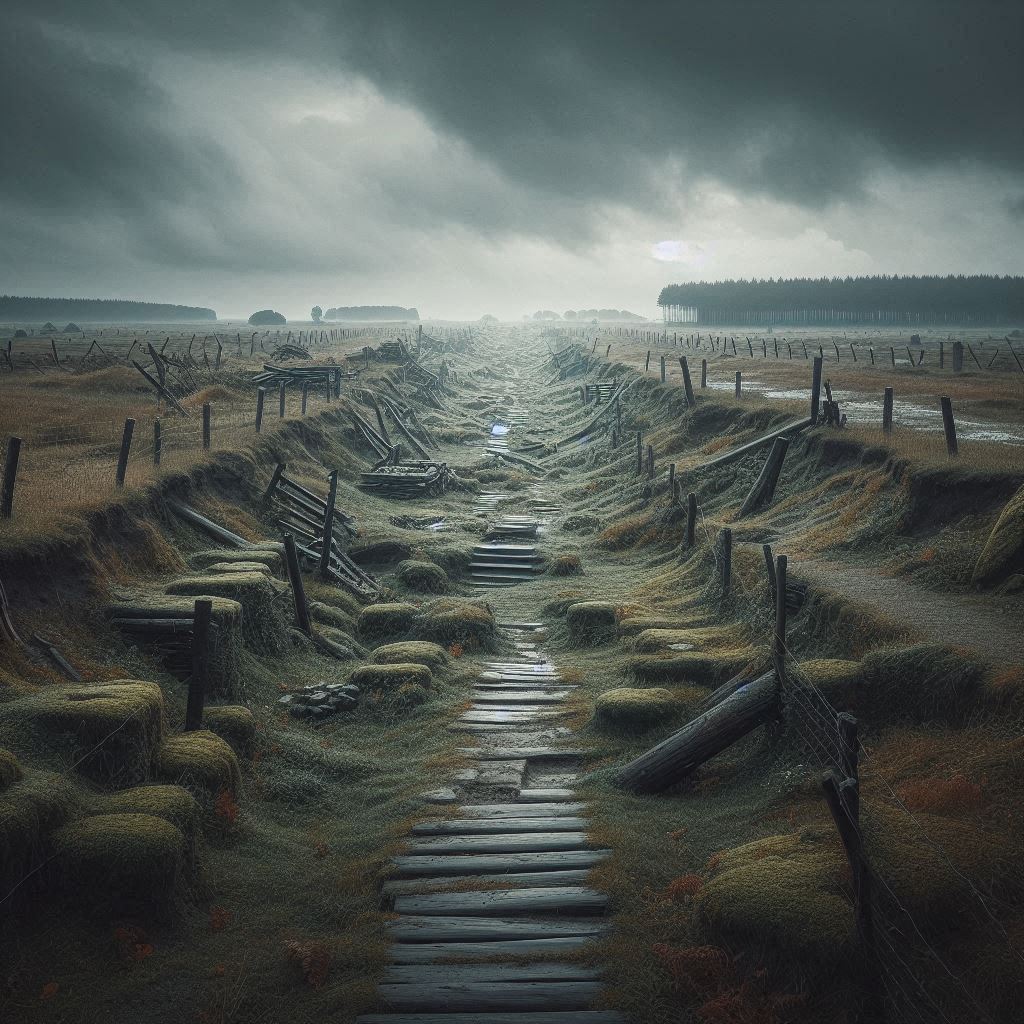
Image. “post war landscape,” image generated by Microsoft Bing Image Creator, June 6, 2024

A gloaming light was building, not a single cloud smudged the gradually lightening sky, it was empty, hollow and vast. No birds flew in this void, none drifted on the wing, above the torn-up ground.

Tam’s tiredness hurt, it’d kept him awake. Not a moment’s rest, not a moment’s
escape. But the night had passed, taking its inky black with it and now dawn
was here. It had started as a low burst of light on the horizon. So bright, it had hurt his
eyes, like the flares before an attack. Then the creeping light had advanced laying claim to
the land, an army on the march. Though this army didn’t bleed or break or cry for its
mother.

Maybe it wasn’t the tiredness that hurt. Maybe it was the hole in his side, where
shrapnel had hurried through him. Maybe it was the twisted and broken leg, with
the foot that faced entirely the wrong way, as if it had decided enough was enough
and it was going home, with or without Tam. Pain has a colour Tam realised, and
it wasn’t red. He had imagined it might be, but it was brown and burrowing, and
it sought out the deeper places which were yellow and orange, warm like autumn
leaves or cut and dried hay.

Silence, it stretched all the way up to the hollow sky. Not a sound. Where had
this quiet come from. The world isn’t a silent place. Its all noise, birds, wind,
leaves rustling, the far-off hum of a tractor working its way across a field, people talking,
footsteps ringing on cobbles, the caw of a crow. Not silence, the world isn’t
silent. But beneath this empty sky sound was missing. M.I.A

Tam had a pencil, he had paper – Eilidh’s letter. He could write on the reverse, send
her words home with his, tangled together like lovers in the sheets. Funny how
hard it was to get the pencil and letter from his pocket. He drifted, losing himself in
the silence, which seemed to be fading at the edges, blurring, though that could have been
him he supposed. And then there was the finding of words, for here and now they
wouldn’t come, his mind was a fog. He slept, drifting with the red and orange
colours. When he woke he took his numb fingers and forced them to scribe words
upon the soft paper. Paper that had been white and crisp, but to reach Tam it
had passed through many hands, and then he had constantly been picking at the
letter, reading it over and over, hearing Eilidh’s voice as he read. Just her
words, her voice and him.

The starkness of the light was wearing out. A gradual fading, a leeching of
substance. The horizon was drawing in, though the sky continued onwards, upwards and
forever. There was noise, a gentle murmur, slowly filling the vacuum, but distant, far
away, somewhere else.

What do you say to someone who knows every part of you when these might be your last words? He couldn’t bring himself to fill this letter with goodbyes.

‘Eilidh,
you wouldn’t believe the skies here. Unbroken, no hills bite into them, they
start
from the flats of the fields and soar upwards. Its rich land, fenland, divided and controlled by canals and ditches. Crops grow tall here, animal’s fat. Not like home, where the sheep cling to the hillsides in feral weather, and the peat water washes brown down to the ocean. I don’t know if I like this land. It isn’t home. But the greater part of not liking it is that you aren’t here. You aren’t under the same sky, you’re beneath another. And I can see you there. I know you there and I know myself there…’

Tam stopped writing.

The noise was deepening. Voices, not the crack of
gunfire, not the screaming of incoming shells. He couldn’t make out the words or the language, no way to know if the approaching talkers were friend or foe. He could cry out, call for help. Perhaps it would come, or perhaps the faces that would peer down at him in his crater wouldn’t be friends. He was beyond war, he was no threat now, his body was a twisted mess, but would they deliver mercy and if so what sort? A bullet to put the man out of his misery or a stretcher to see if he could be put back together again.

‘Eilidh, I know who I am when I am under the same sky as you. I miss that. I miss you. I miss us.’

A dirt covered face appeared at the edge of Tam’s hole. Tired eyes considered
him. Voices, words, all of it blurring at the edges.
The sky was vast and open.
Tam held out the letter.

© Juliet Robinson 2024, all rights reserved.