Harriers and Guilt

It was a splendid summer morning, warm with no breeze and not a cloud in sight. To Harry it had seemed as if nothing could go wrong. The day lay before him, and he was free as a bird. He would take the path over the hill and stop by the Horse and Cart for a drink.

He wasn’t even at the ridge when the Harrier came along the valley skimming the fields and trees. He felt as if he were a God as he looked down on the plane. 

It banked – movements so precise they seemed impossible. Then something went wrong. It pivoted. Spun sideways. Catherine wheeled and slammed into the hillside below Harry. Smoke and debris plumed skywards and moments later a ground shaking roar blasted him. Before he knew what he was doing he was running down the slope towards the burning wreck.

It was raging inferno when he reached it, molten and twisted metal, heat so fierce his skin crackled. But despite this he tried to reach the pilot.

*

Inga had printed the directions before she left the office, but somewhere along the winding roads a left or a right had gone awry and now she was geographically embarrassed. Though she sensed she wasn’t that lost, things seemed familiar, the way the road swung back and forth across the hillside and slunk between ancient bands of trees. She had known before she set off that this wasn’t far from where Jay had, had his accident. His memorial service the year after had been held in a small grey stone church halfway up a hill, very like this one.

Had that really been forty years ago?

The church had been nestled into the hillside only a mile from the crash site. At the end of the service, she had loitered near the kissing gate, as her sister, now a widowed thanked the minister. A man dressed in a shabby but immaculate suit, lingering at the back of the churchyard caught her eye. One side of his face was a raw puckered ruin, he reminded her of the veterans who drank in the village pub, but she was young. She had asked her asked her father who the man at the back of the church was, and apparently, he was the witness to Jays plane go down. She made to approach him, but he had cut and run the second he saw her headed his way. His haunted face had been seared into her mind though, gaunt checks, shadowed eyes, fire ravaged skin.

The road turned back on itself and there buried in the hedge was a rotting kissing gate.

*

It was a splendid summer morning, warm with no breeze and not a cloud in sight. Harry shut the shed door behind him and wondered what he might do with the rest of his day, he had finished clearing the ivy from the crypts far faster than he had expected. A car door slammed out on the lane, likely someone coming to view the commonwealth war graves, tourists often stopped in to see them. A woman of about his age was standing in the shade of the kissing gate when he reached it.

‘Can I help you?’

‘I don’t know maybe, I’m lost but other than that, there used to be a church here, right?’ She wasn’t looking at him, but past him into the graveyard.

Harry nodded, ‘Yeah it burnt down a few years back.’

‘Oh.’ A frown flashed across her face. ‘My brother-in-law had a plaque there; I can’t believe we didn’t hear about the fire.’

Harry’s heart stuttered and not just because of his arrythmia. ‘Jay Roberts?’

She turned to him, looking at him properly, her eyes lingered on his scars for the familiar second, ‘Yeah. Was this your church? Were you the minister?’

‘No, I just keep the place tidy.’ She was frowning again; it seemed an expression that came easily to her. ‘I saw the crash.’ Harry whispered.

Her eyes snapped back to him, ‘You were at his memorial.’

‘I wanted to speak to his widow, I wanted her to know I tried, I did, but …’ Harry’s gut twisted, he had been waiting for this reckoning.

She smiled sadly, ‘There was nothing you could have done.’

Then they were embracing, though Harry wasn’t sure who had initiated the hug. When they broke apart, he was lighter, the guilt he had carried having finally found release. He helped the woman -Inga on her way and asked that she pass on his regards to her sister, who he learnt had remarried. He asked after the two children he remembered from the funeral, now both in the forties, with kids of their own. Before she left Inga paused at the gate, ‘I’m glad he wasn’t alone, that you were there.’

‘I did little good.’

‘You tried.’

© Juliet Robinson 2025, all rights reserved

Mind Burble

This is another blending of truth and fiction. Though for the most part this is a true story, names have been changed and Harry was not injured on the day. He and Inga (my mum) did however meet like this forty plus years after the death of my uncle.

I don’t know what the chances of that were, getting lost in the Lake District, stopping at a familiar landmark to ask for directions and the person who you approach for help is the one who witnessed the death of your brother in law. isn’t the world a strange place? As you can imagine this chance meeting had a big effect on my mum. What were the chances? Have you ever experienced something like this?

Stumbles

It’s been a long summer and creativity has fled!

I don’t expect I am alone in finding the summer a poor time for writing.

The weather is better (well I do live in Scotland, so it remains fickle) and it draws you out and with no school to occupy my child … the limited free time I have to write vanishes.


Autumn and winter for me are deeper times of creativity. I feel more myself in the Autumn, and in the winter, I turn into a cave dwelling hermit, so writing is easier!

Hopefully now schools back on I might find my muse again?

Freya enjoying a slow walk
My favourite tree – well one of them
Yellow Craigs Beach

Dook

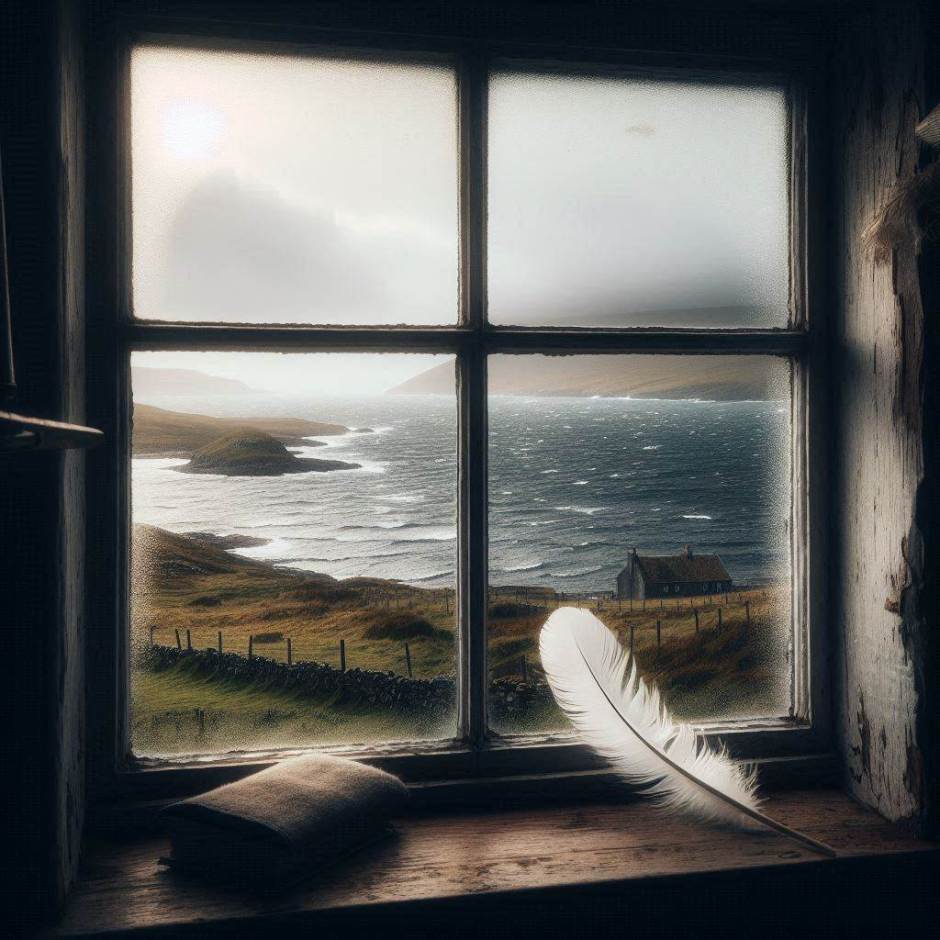
View from a crofts window looking out at the north sea, Bing Image Creator

I tried the window, but it wouldn’t budge. Painted shut. The room was stale. There was a scent swirling amongst the dust motes that I couldn’t quite pin down, feathers, old pillows. Whatever it was, it wasn’t pleasant. I peered out at the darkening sky, clouds where creeping in, soon I wouldn’t be able to see the hills across the water.

The bed was damp and unaired, the sheets clung to me, and a chill settled upon me. My stomach growled, I should have eaten on the ferry, but the food in the canteen had looked plastic, hardly appetising. And the rolling waves had done nothing to inspire hunger. I turned the light off and darkness swallowed me.

I dreamt I was flying a kite. I stood barefoot on the beach, the icy waves washed over my frozen feet, back and forth, back, and forth. I faced the ocean, but I could sense someone up on the dunes watching me, the creep of their eyes upon me. The wind tugged at the kite. Snatching it and snapping its line.

I woke as the red and yellow kite was swallowed by a towering cloud.

The room was still dank, and the funk of my sleep had done nothing to improve the smell. I pulled on the thick woolen jumper I had picked up in a charity shop while waiting for the ferry. It prickled my skin, but it was a barrier to the cold. The curtainless window revealed a dreary day, with heavy clouds. White horses raced over the waves and for a moment I thought I saw something breach, a fin, or a tail, but it was engulfed and lost from sight almost instantly.

Something fluttered by the window. I moved closer to the jack frosted panes of glass. It was a bird’s wing, the rest of the creature was a fetid mass, stuck to the rotting wood of the window frame, but its wing was flight ready. I watched it twist in the wind and remembered the kite.

Nobody was about downstairs, but the water in the kettle was still hot. I made myself a cup of tea, which I drank in a hurry. It sloshed in my empty stomach stirring a sense of nausea. I needed to eat something.

The fridge was empty except for some wilted celery, a crumb covered lump of butter and tub of chopped up bait. A search of the cupboards revealed various aged tins and a packet of half-eaten mince pies which were nearing their first birthday. I hate mince pies, but I don’t function when I’m hungry.

Picking pie from my molars with my tongue I wandered down to the beach. The wind turned my hair into a mess of writhing snakes, which whipped and snapped at my face. I could feel the pounding of the waves through the soles of my boots. I stood just out of their reach and watched as they threw themselves on the sand with frantic hunger.

I was hypnotised by their energy and didn’t hear Magda until she spoke, her words soft and warm in my ear, ‘Did you bring your wetsuit?’

I laughed, of course I hadn’t. No time for that, as soon as I had hung up the phone I was in the car, on the road, on my way here.

‘Only a fool would swim on a day like today,’ she concluded. But there is a challenge in her voice.

For a moment neither of us moved. Statue still. Runners poised at the starting line. Then I was a tangle of limbs, twisting, pulling, hurriedly ridding myself of my clothes. The bitter wind lanced through my exposed skin. Beside me Magda skipped on one leg as she tried to pull her foot free from her jeans. I gave her a shove and she fell bare arsed on the cold sand with a satisfying slap.

Then my sister and I are naked as we were when our mother pushed us out of the womb we once shared. I grin at Magda, and she returns my smile, for hers is mine and we run, full tilt into the wild ocean.

© Juliet Robinson 2024, all rights reserved

two wild swimmers on a Scottish Island – Bing Image Creator

Under the Apple Tree

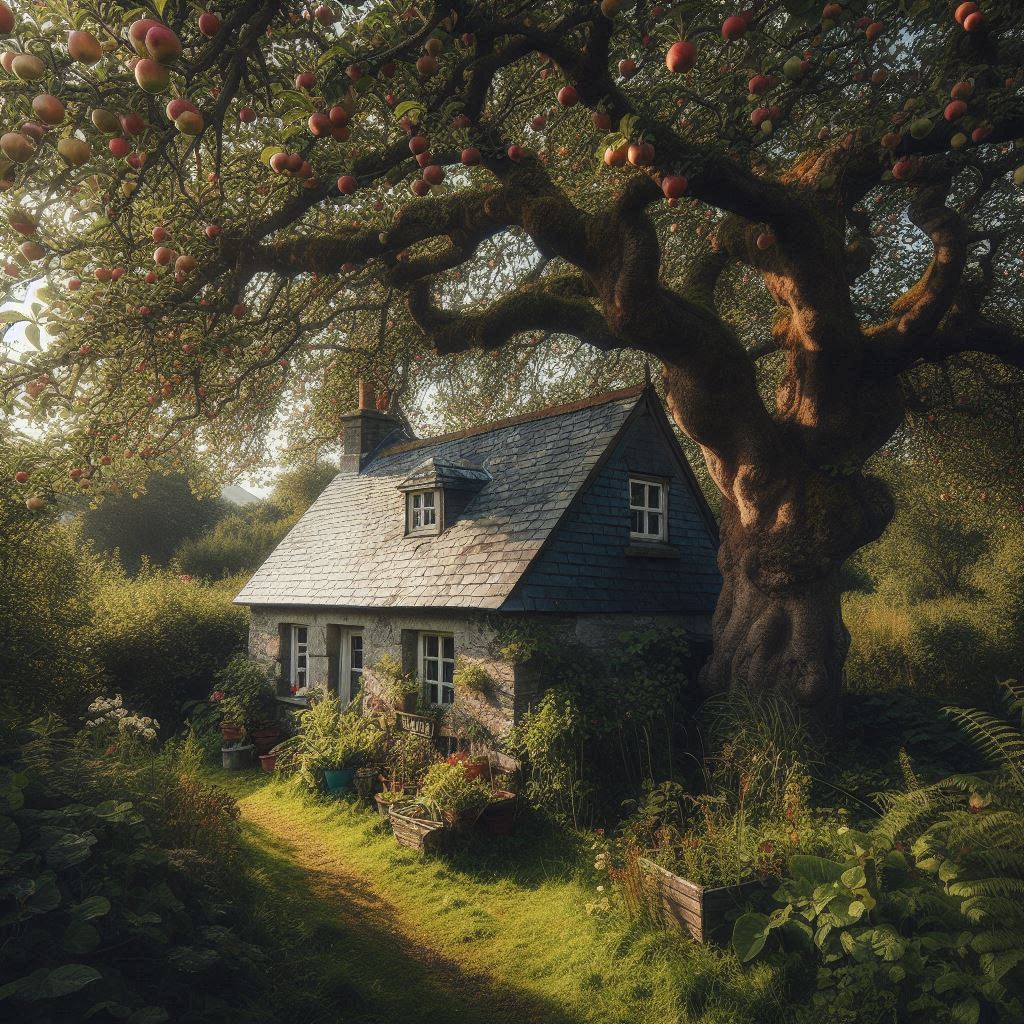
Image. “ramshackle cottage under a large apple tree,” image generated by Microsoft Bing Image Creator, June 17, 2024

Let me tell you about my mother. This morning when making coffee, the percolator boiled over and the smell of burnt coffee, the toasting bread, and the jam was like a conjuring. I wasn’t in my own home, in a rush, half-dressed and wondering why I hadn’t gone to bed earlier, and worrying about the school run, or work, or how I was to walk the dog and still have time to make lunch. I was young again, maybe five, though I could have been any other age between five and leaving home and I was in another kitchen.

My mother’s kitchen, with its low oak ceiling, stained from years of cooking, with the small window which was always covered in pots of parsley, chives, basil, rosemary and coriander all wilted and straining for the light. With the too much stuff piled around the counters, books, opened letters, chopping boards, half-drunk cups of coffee, the toaster that had never worked – sometimes burning the bread sometimes returning it with a mild tan but it was such a pretty colour that we kept it, the postcards peeling away from cupboard doors and the notes, little nippets of a thought, or a message from someone saying we needed milk.

In the house under the tree time was a funny thing, it was endless, all stretched out, and slow, not like the present where all it seems to do is hurtle along racing towards what I don’t know or perhaps I do know and I don’t like to think on it. Time is a trickster just like the devil supposedly is, or was, or isn’t depending on your beliefs.

My mother fell on the wrong side of time, or the devil if you would believe her mother who knew much of such matters and had solely given herself to the one god and his son, but it was my mother that the smells brought through time, or perhaps it was me who was cast back in time, either way not her mother.

My mother was late to be born, nearly a month, not the September baby she was meant to be but an October one. October the tenth month of the year, though it to is out of place or time, since originally it was the eighth month of the year, hence its name – ôctō. October, an autumn month full of fat trees, branches hanging with fruit, like the cooking apple tree which half swallowed our house and dropped swollen apples upon the roof when the wind was up, which it normally was and we half thought the ceiling would come down upon us, but the slate was strong and backed with oak so it never did.

My mother was too early for her own wedding and had time to think it over and leave, because it was the right thing to do, but for her mother this was the end of the familial bond, for she left my mother that day, even as my mother took me with her, because I was there, just a small seed of a person growing in the cup of her womb.

My mother knew there would be other men, kinder, gentler, meaner, richer, uglier, wiser and all the things that any person can be, and there were, for my sister came along and then my brother but he wasn’t meant for the world yet, so he left and perhaps might come back another time and we will know him if he does. But no man ever stayed in the house with the too full kitchen and I think maybe my brother knew this was not a space for men, or maybe it might be in another time, but it wasn’t then.

So it was just me, my sister and our mother. Our mother whose heart tried to break, not from the ache of love, but from disease and when we were only little she nearly left us, but she didn’t, they did things in hospital and she came back. But I remember her not being there and other women coming and looking after us and they were like my mother in that they were kind, gentle and soft and they spoke in low voices until my mother came back and rested in bed. While she took rest we watched all the tv in the house under the apple tree, and the other women took us to school, brushed our hair, washed our clothes and cooked food that wasn’t ever quite right.

And then one morning my mother was back in the kitchen with the hazy green light from all the plants throttling the window, burning the coffee, shouting at the toaster, spreading the jam, stuffing the lunch boxes, feeding the dog and hustling me and my sister out the door to school.

But she was on borrowed time, or out of her time, for it kept on trying to take her, and it became like a game, she would go to hospital, the women would come and then my mother would return and for a while things would be as they were meant to be, but then back to the hospital she would go, before home again, and we came to depend on her return. It was like a game, a tug of war between time, my mother’s broken heart, the hospital and us, and our life in the house under the apple tree. She always came back to us, a little less herself, a little hollower and more fragile, but home again.

And this went on for a number of years. We became complacent, it was expected that she would always get better. So when time finally took her and didn’t send her back a promise was broken.

© Juliet Robinson 2024, all rights reserved.

Mind Burble

This piece was an attempt at telling a story as a stream of consciousness. I really enjoyed writing it, the deliberate repetitions of ‘my mother’ and ‘under the apple tree’ felt right given the flow of the story. When I had a friend read the piece out loud to me I felt they sounded particularly effective.

The story is vaguely based on life experience – the mothers health issues and the giant apple tree in particular. My mother passed away three years ago and one of the things I have found helpful for my grief is infusing her, my memories of her and stories she told me into my writing. I play with the truth of things, but often I don’t need to, my mother had an interesting life and she was quite a character.

I enjoyed drawing on the symbolism associated with apples in this story. In Norse mythology, the goddess Idunn guards apples that grant the gods immortality. This links the apple to everlasting life and the fight against death which felt right given the mothers battle with heart disease. I also drew a vague link between the idea of time being a trickster, my mention of the devil, and the fiercely religious grandmother with apples and the garden of Eden – this was stretching it a wee bit!

Thank you for reading!

Pandoras Box

Doctors, nurses, and specialists all become familiar

I can crush my feelings and fears

I can scream silently in the shower

I can smile while inside me continents smash apart

I sense myself becoming something other

My insides seem bigger than the shell of my body

© Juliet Robinson 2024, all rights reserved

Mind Burble

This is an excerpt from a longer piece which I wrote about my son and his congenital heart disease. I hope to do something with the complete piece in the future. It is the hardest thing I have ever written and certainly the most personal. I found that as I wrote about his journey and what we went through there were things I couldn’t say without breaking into poetic prose, so throughout the story, there are sections like the above part.

Writing about personal grief is a new thing to me. Yes, I spend a lot of time crying when I write about my son or my mother, but I feel lighter, perhaps not always better, but unburdened. It is helpful.

My hope is that my story Pandoras Box will help raise awareness of congenital heart disease. Congenital heart disease is one of the most common types of birth defect, affecting up to 9 in every 1,000 babies born in the UK. During our time in Great Ormond Street we met many other wonderful children who like my son had been born with congenital heart conditions. Their strength and bravery, and that of their families was both inspiring and humbling. Heart Warrior Children are amazing.

Today was my sons bi-annual check up at the hospital and he did amazingly. His heart is functioning brilliantly and we don’t need to go back for another two years unless things change, but touch my wooden head hopefully they wont. I am so proud of him.

Congenital Heart Disease – Bing Image Creator